Tuesday, October 22, 2013

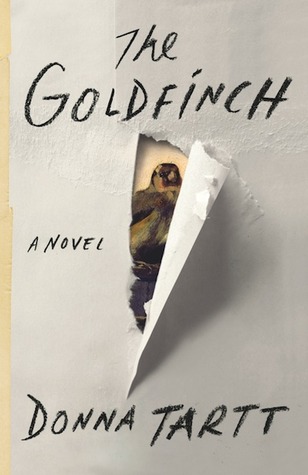
The Goldfinch, Donna Tartt

The GoldfinchWhen I was still in Amsterdam, I dreamed about my mother for the first time in years. 

"Composed with the skills of a master, The Goldfinch is a haunted odyssey through present day America and a drama of enthralling force and acuity. It begins with a boy. Theo Decker, a thirteen-year-old New Yorker, miraculously survives an accident that kills his mother. Abandoned by his father, Theo is taken in by the family of a wealthy friend. Bewildered by his strange new home on Park Avenue, disturbed by schoolmates who don't know how to talk to him, and tormented above all by his unbearable longing for his mother, he clings to one thing that reminds him of her: a small, mysteriously captivating painting that ultimately draws Theo into the underworld of art. As an adult, Theo moves silkily between the drawing rooms of the rich and the dusty labyrinth of an antiques store where he works. He is alienated and in love-and at the center of a narrowing, ever more dangerous circle."

I somehow have not read The Secret History yet, but after reading this wonderful (and long) novel, I'll definitely be picking it up. Like most, I was a bit intimidated by The Goldfinch's length originally, and I put off starting it for a couple of days. But as soon as I began to read, I was drawn into Theo's singular story, and his both clear-eyed and not way of narrating. Only 12 pages in, I was already hooked. That's the power of a great writer for you. 

There are so many heartbreaking events in this novel, random twists and turns of fate. After all, in the very first few pages, it's just sheer chance that Theo's mother gets sick in the cab, they have to get out, it starts to rain, a businessman gets the last taxi, and they decide to take shelter in the museum. That short section was so beautifully written, especially for one who knows what's going to happen. The sequence afterward the accident was brilliant too, brilliant and dream-like. Really, the entire book is composed of stunning language and beautiful, disturbing snapshots. Characters, places, and events were beautifully described and portrayed. Donna Tartt's writing style is a bit dense and descriptive, but it didn't feel overwritten; it felt amazingly perceptive and smart. Tartt also builds dread amazingly well, in the aftermath of what happens in the museum and later on. There's great foreshadowing in The Goldfinch.

The Goldfinch has been called Dickensian many times, and that's fairly accurate. The writing is not very similar to Dickens (although there is a lot of description), but the overarching story could be, with strange and cruel twists of fate and fortune, and some very unique, twisted characters. What happens to Theo after the museum is quite improbable: he is abandoned by his father and ends up living with his old school friend on Park Avenue, while meanwhile serving as a sort of apprentice to someone who died in the museum right in front of Theo's eyes. And that's the whole similarity to Dickens. The Goldfinch also has a lot of Gothic elements to it.

The central symbol and motif of the whole novel is, of course, the small painting of a captive goldfinch that Theo dazedly steals from the museum. As the story unfolds, it becomes to him a talisman of his lost mother, something tangible to remember her by. After all, it was one of the paintings she loved the most, and as the days go by it becomes harder and harder for Theo to think of a way to return it. The irony is, that it turns out for many years he didn't actually have this painting that became an object of dread for him. I'm being vague on purpose of course.

There were some great descriptions of the city and of other places too, and I really enjoyed reading about Theo's relationship with many of the other people in the novel, particularly Hobie, the friend of the old man who died, and Boris, who he meets in Las Vegas. The Las Vegas section was kind of the most depressing, especially since I can related to the whole New York longing thing (sort of). Boris, however, was a character both humorous and sad at the same time, and he was quite irresistible. I didn't really like their whole relationship though, and it was awful to see Theo turning away from his old life and using drugs and all of that.

The Goldfinch is so, so enthralling and I absolutely loved both the plot and the writing. I would highly recommend this excellent, smart, literary novel, and I'm very glad that I read it. Even though it's long, it's still definitely worth the time spent on it. There are a lot more things I could say about the book, but the problem is they've already been said by other professional reviewers: here and here. Go check out those reviews; they're amazingly well crafted, although not as well crafted as this marvelous book.

I received a review copy of this book from Little, Brown; thanks so much! It just came out today; go check it out, preferably at your local bookstore (although the Amazon link is here).

771 pages.

Rating: *****

Monday, October 21, 2013

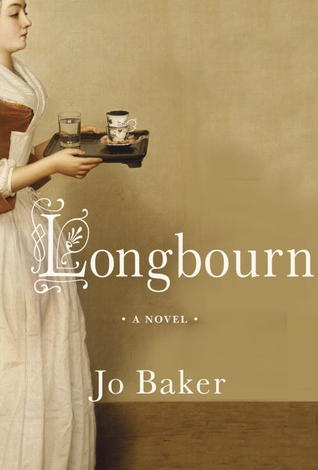
Longbourn, Jo Baker

LongbournThere could be no wearing of clothes without their laundering, just as surely as there could be no going without clothes, not in Hertfordshire anyway, and not in September. Washday could not be avoided, but the weekly purification of the household's linen was nonetheless a dismal prospect for Sarah. 

"If Elizabeth Bennet had the washing of her own petticoats, Sarah often thought, she’d most likely be a sight more careful with them. In this irresistibly imagined belowstairs answer to Pride and Prejudice, the servants take center stage. Sarah, the orphaned housemaid, spends her days scrubbing the laundry, polishing the floors, and emptying the chamber pots for the Bennet household. But there is just as much romance, heartbreak, and intrigue downstairs at Longbourn as there is upstairs. When a mysterious new footman arrives, the orderly realm of the servants’ hall threatens to be completely, perhaps irrevocably, upended. Jo Baker dares to take us beyond the drawing rooms of Jane Austen’s classic—into the often overlooked domain of the stern housekeeper and the starry-eyed kitchen maid, into the gritty daily particulars faced by the lower classes in Regency England during the Napoleonic Wars—and, in doing so, creates a vivid, fascinating, fully realized world that is wholly her own."

I heard about Longbourn on Goodreads and immediately wanted to read it. I was lucky enough to obtain a review copy from Knopf Books, and I wasn't disappointed, even though Longbourn was a bit different than what I was expecting. Jo Baker doesn't really try to imitate Austen's style, unlike most books spin-offs. But then, this isn't really a spin-off, not as we know it. It's more like a revelation of what the other side of Pride and Prejudice was. It's something I've often wondered about, about how the servants at Longbourn and other places lived, and what their relationships to their employers were like. Well, Longbourn answers that question, and exceedingly well. The writing is rather distinctive, and unlike Austen, there's a lot of description, which I rather liked. After all, so many aspects of the servants' lives are so foreign to the modern reader, and some parts of the book would have been a little confusing without the elaboration.

Unlike the plot summary says, Longbourn isn't "the answer" to Pride and Prejudice; it's just a look at what's hidden underneath those fine ladies and gentleman, at the people who wash their clothing and empty their chamber pots, who rise at four thirty in the morning and go to bed at eleven. It's a grueling schedule, and it made me wince to read about, especially considering what little work even people like the Bennets did. Nothing, really, and indeed in Pride and Prejudice Mrs. Bennet is offended at the idea that her daughters would cook a meal. The Regency class system really comes to light in this book.

Longbourn also provides some insight into the already established characters of P&P, painting a clearer portrait of them from the servants' perspective. This is also enhanced by little snippets from the original novel at the beginning of each chapter; they kind of tell the reader what to watch out for. For example, in a chapter featuring Mrs. Bennet, the quote reads "the business of her life was to get her daughters married; its solace was visiting and news." These stand in place of chapter titles.

Longbourn also holds plenty of new and interesting characters, such as the enigmatic new footman who Sarah dislikes and likes at the same time. Sarah narrates most of the book, although it is in omnipotent third person, so sometimes Jo Baker writes from the perspective of Mrs. Hill, James, or one of the other servants. Sarah herself is mentioned but once in P&P, when Mrs. Bennet frantically shouts for her to "come to Miss Bennet this moment, and help her on with her gown." I thought I remembered that detail, and was happy that the author picked up on it.

The book isn't witty or wry like Jane Austen's novels, and the story doesn't consume you quite as much, but I still really wanted to see how the book unfolded and how Jo Baker would portray the novel's events from the servants' point of view, which is obviously vastly different. They also know about some events, but not others.

Although I am not one of them, there are many people who completely romanticize Jane Austen's world and want to be Elizabeth Bennet, and books Longbourn remind us of why exactly the early 1800's were a pretty terrible place to live in. Women had no rights, and unless you were a member of the upper class, life pretty much sucked. There's an interesting section at around page 56 when James drops the ladies off at the assembly, and it shows the vast difference between what happens in the light and outside and how the coachmen waiting outside interact, living in squalor. There's actually a couple-second scene like this in the 1995 adaption of Pride and Prejudice, probably where Jo Baker drew it from. It's sections like these that really make the novel shine.

As others have commented, Longbourn does really stand on its own as an excellent historical novel about class and social situations. Non-Austen fans may enjoy it too, and I loved its portrayal of a different, more realistic side of the story. I also just really enjoyed how the familiar characters were developed and explored in interesting new ways, and I would definitely recommend this very creative book. You can read another review here.

332 pages.

Rating: ****

Sunday, October 20, 2013

The Irresistible Blueberry Bakeshop & Cafe, Mary Simses

The Irresistible Blueberry Bakeshop & Cafe"Don't move, it's not safe!" I heard someone yell, but it was too late. The wooden planks of the dock sagged beneath me and then gave way. Boards splintered, rotted lumber snapped, and I plunged ten feet into the frigid Maine ocean.

"A high-powered Manhattan attorney finds love, purpose, and the promise of a simpler life in her grandmother's hometown. Ellen Branford is going to fulfill her grandmother's dying wish--to find the hometown boy she once loved, and give him her last letter. Ellen leaves Manhattan and her Kennedy-esque fiance for Beacon, Maine. What should be a one-day trip is quickly complicated when she almost drowns in the chilly bay and is saved by a local carpenter. The rescue turns Ellen into something of a local celebrity, which may or may not help her unravel the past her grandmother labored to keep hidden. As she learns about her grandmother and herself, it becomes clear that a 24-hour visit to Beacon may never be enough." 

I heard about this book when it first came out in summer 2013, but didn't get around to reading it until now, courtesy of a review copy sent by the publisher. As one might expect from the plot summary, title, and cover, it's a light, sweet, and purportedly heart-warming read. The marketing heavily emphasizes its supposed similarity to The Guernsey Literary and Potato Peel Pie Society, but although the basic, basic outlines of the book are the same, they're really only very similar if you leave out all the differences. However, the basic outline for both novels is basically the story of an educated, high-powered city girl expanding her horizons in a small, rather isolated town or community. The Guernsey Literary and Potato Peel Pie Society is a light read too, but it's more cast in shadow by the fact that it takes place right after World War II, and the islanders have had to go through a lot. However, both Juliet and Ellen have an almost too perfect fiance, and find something else, something simpler, "truer", in Guernsey and Beacon, respectively. With both books, too, one initially thinks that the fiances aren't too bad, but it's revealed that they definitely have some problems, as opposed to the country person she meets. It's not a particularly good plot line, but it worked for The Guernsey Literary & Potato Peel Pie Society, and also for The Irresistible Blueberry Bakeshop & Cafe, though not quite as well. This story is much sillier, although it's still about someone reconsidering her entire life after a trip to a small, close-knit place. I would say that this book is vaguely reminiscent of Guernsey, but it certainly lacks much of the pathos of the aforementioned novel because although there is an undercurrent of grief from something that happened sixty years ago, it's not on as big of a scale.

This novel is like Lite fiction. So lite, it was almost too lite. I mean, it was so sweet, and gooey, and it completely romanticized the whole quaint small town thing. Generally, we read about Southern towns being full of malice hidden by honeyed sweetness, but I'm sure it happens in Northeastern towns too, although probably less so. Let's face it, there are some major disadvantages to living in a place like Beacon as opposed to Manhattan, which is where Ellen lives. I know I'd choose Manhattan any day. This really isn't generally my type of book, with the overboard sweetness. It's certainly supposed to be a feel-good read, but I only felt vaguely guilty that I'd actually taken the time to read a book like this. Basically, the title immediately conveys exactly what kind of a book this is.

That said, it's not badly written per se, and it will definitely appeal to some people. The Irresistible Blueberry Bakeshop & Cafe is just what it purports to be; it's not anything very literary, and it's hardly an emotional book. It's just about different living styles, and a high-powered person taking the time to actually slow and down and look at things and eat good (if fattening) food. Speaking of which, there were almost too many descriptions of food in the book. I mean, yes, they were mouthwatering, but it was kind of unnecessary and many of the descriptions felt as if the author was just indulging herself; they added seemingly nothing to the story itself.

Nevertheless, I liked the book for it was, and nothing more. If you like this sort of thing, then go ahead: indulge yourself. Read it, enjoy it. It's just not my normal preference. Sometimes, I'm in the mood for something mindless or something sweet. Apparently I wasn't here, or perhaps this book was just a little bit too mindless and sweet. But I did read it pretty quickly, and it was absorbing enough, even if I did roll my eyes a lot.

341 pages.

Rating: ***

Saturday, October 19, 2013

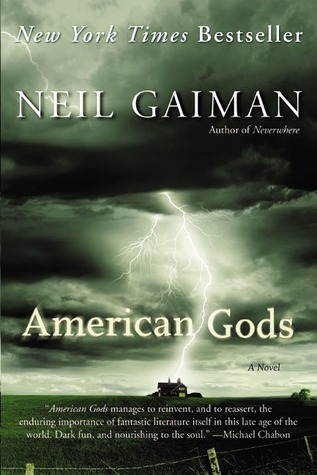
American Gods, Neil Gaiman

American GodsShadow had done three years in prison. He was big enough and looked don't-f**k-with-me enough that his biggest problem was killing time. So he kept himself in shape, and taught himself coin tricks, and thought a lot about how much he loved his wife.

"Released from prison, Shadow finds his world turned upside down. His wife has been killed; a mysterious stranger offers him a job. But Mr. Wednesday, who knows more about Shadow than is possible, warns that a storm is coming -- a battle for the very soul of America . . . and they are in its direct path." You can find a more in-depth but not necessarily more accurate description on the Goodreads page. There's also a great quote there from Therese Littleton (whoever she is) about the book: "More than a tourist in America, but not a native, Neil Gaiman offers an outside-in and inside-out perspective on the soul and spirituality of the country--our obsessions with money and power, our jumbled religious heritage and its societal outcomes, and the millennial decisions we face about what's real and what's not."

Wow. American Gods is definitely a difficult book to write about. Despite the summaries, it's the whole of the book, all the many stories that tell you what it's about, not the two or three paragraph summaries provided by the publisher. It's really a weird, sprawling story about the nature of America, of the crashing together of all these different beliefs in the great melting pot that is the United States. It's about American belief, it's about that "American" quality (love it or hate it) that pervades the country, that sense of freedom and openness and don't mess with my rights that I imagine you don't get in Europe or other places. Of course, this same freedom means that there are mass shootings every six weeks (or so it seems), which doesn't happen in Europe and Canada. Or Australia even, which actually banned guns after just one such awful shooting. If you're being really cynical, you could call these countries the real civilized world. But let's not talk about politics, much as I'm tempted (another post maybe, to reveal my liberal, cynical self?) Let's just talk about American Gods, which is an interesting, disturbing read no matter what you think about America. I admire Neil Gaiman, being British for even writing this tome. Of course, he lives in America now, so he's just as knowledgeable as the next person. And, as he points out, almost everyone in America came from somewhere else, like him. Although that's true of everywhere except Africa, the very root of civilization. His point, though, is that besides the (admittedly many) Native Americans, everyone else in America is a relatively new arrival: 16th century or so. Then there are the American gods, gods from all over the world, all gathering, resorting to cheap ways of surviving, in "the greatest country in the world" (sarcasm here). But this book definitely did make me look at America in a slightly different light. Because even if America is obviously not the greatest country in the world (it's probably one of the worst so-called developed countries), it has its points, and it's such a great mix of different beliefs - and gods. Gaiman captures it really well.

American Gods is pretty disturbing; there's a lot of cursing and a lot of sex and a lot of graphic descriptions. These are things you don't generally associate with fantasy. But this is fantasy, Gaiman-style; urban fantasy, if you will, although much of it takes place in the gritty, wild, landscape of rural America. The tone of the book was a bit weird, but it certainly was a nice change. There's trademark Gaiman: the rules of the world turned upside down and given a shake (a rigged coin toss for tails turns up heads at Mr. Wednesday's command). But there's also new things, things I haven't seen in Gaiman's work. American Gods is certainly the most blunt and to-the-point of his novels that I've read.

I kept having the nagging sensation that Shadow was hiding something (or trying to) from Mr. Wednesday, partly because of something I read in a little novella from American Gods in Neil Gaiman's collection Fragile Things. As it turned out, this wasn't really the case (although sort of).

The Zorya's, the first people that Wednesday takes Shadow with him to, were really interesting. They seem to be Russian, although they share some Norse beliefs. The scene where Shadow plays checkers with the male in the house was interesting. The wager is this: if Shadow wins, the man will do whatever sinister thing Mr. Wednesday wanted him to do; if Shadow loses, the man gets to bash his brains in with a sledgehammer. Weird, huh? This was a refrain that continued throughout the book. I also really liked the scene at night with Zorya Polunchnaya on the roof. She says, "The cold does not bother me. This time is my time: I could no more feel uncomfortable in the night than a fish could feel uncomfortable in deep water." She also explains to Shadow that Zorya Utrenyaya was born in the morning, Zorya Vechernyaya in the evening, and she herself at midnight. Then, Shadow tells her about his late-night visit from his presumably dead wife, and when he says he didn't ask Laura what she wanted Zorya replies, "It is the wisest thing to ask the dead. Sometimes they will tell you." It was a dreamy but very interesting and somehow moving scene. 

Shadow encounters so many other unsettling, beautiful, ugly individuals in his "kaleidoscopic journey deep into myth and across an American landscape at once eerily familiar and utterly alien." Gaiman has reimagined America through fantasy, and this book is awesome. I would highly recommend it to all Gaiman and fantasy fans. It's a great novel, filled with coin tricks and strange happenings.

I'll close with a quote from the book, which if not the most illustrative, is a good one: “What I say is, a town isn't a town without a bookstore. It may call itself a town, but unless it's got a bookstore it knows it's not fooling a soul.” So what is it then, if not a town: a wasteland? 

588 pages. 

Rating: ****

Thursday, October 17, 2013

The Signature of All Things, Elizabeth Gilbert

The Signature of All ThingsAlma Whittaker, born with the century, slid into our world on the 5th of January, 1800. Swiftly - nearly immediately - opinions began to form around her.

"Spanning much of the eighteenth and nineteenth centuries, The Signature of All Things follows the fortunes of the extraordinary Whittaker family as led by the enterprising Henry Whittaker—a poor-born Englishman who makes a great fortune in the South American quinine trade, eventually becoming the richest man in Philadelphia. Born in 1800, Henry's brilliant daughter, Alma (who inherits both her father's money and his mind), ultimately becomes a botanist of considerable gifts herself. As Alma's research takes her deeper into the mysteries of evolution, she falls in love with a man named Ambrose Pike who makes incomparable paintings of orchids and who draws her in the exact opposite direction—into the realm of the spiritual, the divine, and the magical. Alma is a clear-minded scientist; Ambrose a utopian artist—but what unites this unlikely couple is a desperate need to understand the workings of this world and the mechanisms behind all life.Exquisitely researched and told at a galloping pace, The Signature of All Things soars across the globe—from London to Peru to Philadelphia to Tahiti to Amsterdam, and beyond. Along the way, the story is peopled with unforgettable characters: missionaries, abolitionists, adventurers, astronomers, sea captains, geniuses, and the quite mad. But most memorable of all, it is the story of Alma Whittaker, who—born in the Age of Enlightenment, but living well into the Industrial Revolution—bears witness to that extraordinary moment in human history when all the old assumptions about science, religion, commerce, and class were exploding into dangerous new ideas."


I was expecting to love this book, and I did. It was a bit different than I thought it would be, but nonetheless a marvelous work in many respects. I've never read Elizabeth Gilbert's famous memoir Eat, Pray, Love, or any of her fiction, but I might pick them up in the future if I get around to it. Despite the fact that it was the plot that drew me in, it was the writing that made me stay and enjoy this novel. I just loved the vaguely 19th century narrative style of the book, faintly reminiscent of Austen (and indeed, in the press packet, Gilbert says that Austen was one of the 19th century writers she read in preparation for the book). There was also that singular way of speaking directly to the audience at times, such as towards the beginning of the novel when Gilbert shifts away from Alma's story to talk about her father's early life, saying "how her father came to be in possession of such great wealth is a story worth telling here, while we wait for the girl to grow up and catch our interest again." (pg. 7). If every book was like this, it would be rather annoying. But as it is, this style was amusing and fitting for the book. It's also one of those rather long novels with lots of great, diverting side-notes, and yet it's not overwritten at all. The Signature of All Things is compulsively readable and extremely compelling. 

Elizabeth Gilbert's style is also one of little dialogue and lots of narration, except for specific dialogue-heavy scenes. Again, I wouldn't want to have every book I read be something like this, but it worked here, and I didn't find the novel boring. At all. It was thoroughly absorbing, and I found Alma a fascinating character. In fact, all of the characters were really interesting, none of them being totally good or bad, all of them with sympathetic sides. As Elizabeth Gilbert says in the aforementioned interview, there are no real "villains" in the story, only complicated, flawed people, all of whom were fascinating to read about, particularly in the early sections, Alma's parents, who I at times disliked and admired. I particularly found Alma's father, the at times vicious, at times loving Henry Whittaker an interesting puzzle. He made his immense fortune by less than gentlemanly means, and yet as Gilbert points out, he'd be the first to admit it. And he is kind - sort of, in his own way.

The story itself is just utterly fascinating and engrossing, and so, so creative. The novel spans the entire century during which so much new scientific exploration was done, and religion and science sort of began to clash. In the interview (which isn't in the actual book; sorry), Elizabeth Gilbert pointed out some really interesting things, such as how painful that split was for many people who had to choose between wholehearted religious belief and science (although not everyone had to choose, of course). However, when Alma is first born and as she grows up in the early 19th century, belief in both is still entirely possible, but through the lens of her intriguing life we see everything on that front change. I've never quite been able to put my finger down on why I'm really interested in the 19th century, and maybe this is part of the reason, because the transition into the more modern world really begins in the 19th century, and I enjoy reading about the changing sensibilities of the time. Elizabeth Gilbert really captures the wonder of the time, the sense of everything being really new and just waiting to be discovered. There were so many unknown creatures and plants that it must have been almost magical to be part of that. Today, there are still many scientific things we don't fully understand, and many organisms that we don't know much about, but most of them live deep in the ocean and thus are less relatable, I suppose you could say. She also portrays the opportunism that was there for those clever enough to take it, such as Henry Whittaker, who uses new natural discoveries and his experience in botany to make fabulous amounts of money. It was also the beginning of a time when the heretofore rigid class structure started bending just a little bit, as evinced by the fact that Henry, who was born in abject poverty, becomes one of the wealthiest men in the New World. There are so many new markets opening up on various fronts and class barriers breaking down, and this expansive novel really covers a whole lot of extraordinary things that were going on in the 19th century. Obviously, this process was continued throughout the early twentieth, but it really started here.

One of the other topics addressed in the book is that of 19th century views on sexuality, which is also very interesting. It's quite closeted (in Alma's case, literally), and talking about such things is rather frowned upon, especially for women. It's quite natural though that an intelligent young woman like Alma would want to know about these things, and that was an enjoyable part of the book, although it did strike me as a bit odd at first. As Gilbert mentions in the interview, The Signature of All Things also has many portrayals of flawed marriages, of women stuck in them. What I found particularly striking here was that it's not that either of the people are bad per se; they're just ill-suited to one another, and in the 19th century there's not that much you can do about it once you're married. She's talking about the marriages of the three friends, Alma, Prudence, and Retta (who's quite mad), but I think it could be applied to a lot of people both in the novel and out.

I believe that in her memoir Eat, Pray, Love, Elizabeth Gilbert travels to various places across the globe, and The Signature of All Things takes place in many parts of the world, though chiefly Philadelphia, but also "from London to Peru to Tahiti to Amsterdam." There were many both beautiful and disturbing settings, but also compelling evocations of so many exotic places in many parts of the book, starting off right at the beginning with the story of Henry Whittaker's travels. I loved these scenes, because Gilbert really called up the sights, sounds, and smells of these varied places in colonial times. 

The Signature of All Things is definitely worth all the hype it's been getting of late. It had gorgeous writing and description, fascinating characters, a very creative plot, and it talked about some really interesting ideas and concepts, showing a world on the cusp of the modern age and in the midst of a frenzy of scientific discovery. I would highly recommend this novel. I received a review copy from Viking.

499 pages. 

Rating: *****

Wednesday, October 16, 2013

The Unexpected Miss Bennet, Patrice Sarath

The Unexpected Miss BennetIt is a comforting belief among much of society, that a plain girl with a small fortune must have no more interest in matrimony than matrimony has in her.

"The third of five daughters, Miss Mary Bennet is a rather unremarkable girl. With her countenance being somewhere between plain and pretty and in possession of no great accomplishments, few expect the third Bennet daughter to attract a respectable man. But although she is shy and would much prefer to keep her nose stuck in a book, Mary is uncertain she wants to meekly follow the path to spinsterhood set before her. Determined that Mary should have a chance at happiness, the elder Bennet sisters concoct a plan. Lizzy invites Mary to visit at Pemberley, hoping to give her sister a place to grow and make new acquaintances. But it is only when Mary strikes out independently that she can attempt to become accomplished in her own right. And in a family renowned for its remarkable Misses, Mary Bennet may turn out to be the most wholly unexpected of them all..."

The Unexpected Miss Bennet is one of the best Austen retellings or rip-offs that I've read. Really. Usually retellings of the novels themselves in diary format from the male POV are just tedious, and reading about Elizabeth and Darcy's married life is okay, but not that interesting. Instead, here we have a new story: Mary's story. In Pride and Prejudice, she's the sibling that everyone passes over: Jane is sweet and beautiful, Lizzy is pert, witty, and pretty, and Lydia and Kitty are young and lively. But Mary? She just moralizes and constantly plays the piano without getting better. Until suddenly she realizes that she wants more than just being the musician at Meryton assemblies, and Fordyce's sermons suddenly don't seem so appealing to her anymore. I really love the way that Patrice Sarath brings Mary to life. Suddenly, she's a full, three dimensional character, one we can relate to more, perhaps, then Elizabeth. After all, Mary is plain and until her transformation, dull and annoying, with her constant spouting of not-very-wise (or helpful) wisdom. Maybe it's a bit unrealistic that Mary would wait to have her existential crisis until the age of twenty, but I didn't care. The Unexpected Miss Bennet was a really good book, and I'm glad I finally got a copy of it after waiting so long. 

I really liked the fact that the author talks about Mary and Mr Collins. I've always thought that they would have been a good match, and indeed, so did Mary when they first came. She thinks that they would suit each other really well, but then she realizes that even an odious man like Mr Collins looks right past her, has his eyes set on "higher" prizes, like Jane, Lizzy, and even Charlotte. It was great that that was touched on as a possibility for Mary.

There were a lot of really funny moments in The Unexpected Miss Bennet, moments when Mary finally stops being so stuffy and jokes around a little bit (or what passes for joking in Regency England). When Mr Collins calls on her and her father, and Mr Bennet says sardonically, "Upon awaking every morning I ask myself, 'What would Lady Catherine do?'" Although not Mary speaking, that was really funny, and she finds it amusing. Mary and Mr Bennet also become a bit closer, sharing amusement and horror at Mr Collin's conduct, insinuations, and insults. Later, Mary is staying at the Hunsford Parsonage, and Mr Collins is talking about men being schooled and reading to improve themselves. Mary replies, "A pity it doesn't always work." Right back at you, Mr Collins! That was hilarious in a genteel, prim, Regency sort of way. Here's another sly remark on the author's part: "And they [Mr and Mrs Bennet] would stay no more than one night, for neither of them enjoyed being away from Longbourn for very long. For Mrs Bennet, it was her nerves. For Mr Bennet, it was Mrs Bennet's nerves."

Anne de Bourgh, Lady Catherine's sickly daughter, is also developed as a character. This was kind of predictable, as she's the character besides Mary who's least described, but I really enjoyed her portrayal too. This happened in Mr Darcy's Diary but not as much and not as realistically. 

I really liked The Unexpected Miss Bennet's humor, wit, charm, and overall faithfulness to Austen's style. It's a very good Austen pastiche, and well worth reading if you're fond of them. 

296 pages. 

Rating: ****

Tuesday, October 15, 2013

The Kingdom of Little Wounds, Susann Cokal

The Kingdom of Little WoundsIt is while I stitch together the Queen's gown, on the night her eldest daughter is to die, that I first sense an uneasy power.

"On the eve of Princess Sophia’s wedding, the Scandinavian city of Skyggehavn prepares to fete the occasion with a sumptuous display of riches: brocade and satin and jewels, feasts of sugar fruit and sweet spiced wine. Yet beneath the veneer of celebration, a shiver of darkness creeps through the palace halls. A mysterious illness plagues the royal family, threatening the lives of the throne’s heirs, and a courtier’s wolfish hunger for the king’s favors sets a devious plot in motion. Here in the palace at Skyggehavn, things are seldom as they seem — and when a single errant prick of a needle sets off a series of events that will alter the course of history, the fates of seamstress Ava Bingen and mute nursemaid Midi Sorte become irrevocably intertwined with that of mad Queen Isabel. As they navigate a tangled web of palace intrigue, power-lust, and deception, Ava and Midi must carve out their own survival any way they can."

I'm still not quite sure what I think of this book; it's weird, and not very young adult-like at all. The writing is well crafted, but kind of flat as a whole. It's also super graphic and disgusting at times. I do know that the part I read didn't live up to my expectations; the plot sounded fascinating, and it seemed like it would be an engrossing read. Well, it was certainly gross. I gave the book about 80 pages before giving up. Parts of the book were intriguing, but ultimately I didn't have the patience for this long-winded novel. Perhaps if I'd stuck with it a bit longer, I would have been able to get into it.

It's hard for me to pinpoint exactly what about this book was such a turn-off; although how graphic it was was part of it, there was more to my repulsion. There are a lot of simply disgusting descriptions in the book, and the provided summary creates a vastly different impression of the book's tone. I'm happy that the author didn't shirk from talking about some pretty awful things that do actually happen to people; there was just too much, and the story itself wasn't that interesting to me. The marketing was slightly deceptive too.

Ultimately, it wasn't the horrific things that happened in the book, but the style and the slowness of the pace which made me put it down. Maybe it picks up further along, but I wasn't in the mood to read more pages of boring, if gruesome writing. It's a shame too, because I thought I would really like the book. But I didn't, and that's that. I normally like dark fairy tales and fables, but not in this case. The Kingdom of Little Wounds just didn't work for me. I may try again sometime, but I doubt it.

I received an ARC from Candlewick.

576 pages.

DNF.