Monday, October 7, 2013

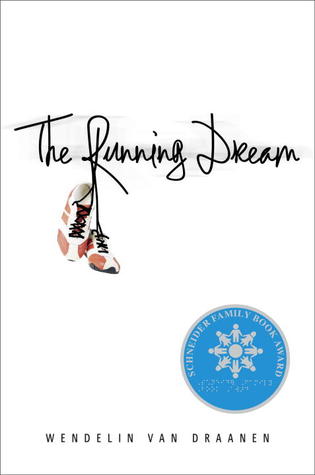
The Running Dream, Wendelin Van Draaen

The Running DreamMy life is over. Behind the morphine dreams is the nightmare of reality. A reality I can't face. 

"Jessica thinks her life is over when she loses a leg in a car accident. She's not comforted by the news that she'll be able to walk with the help of a prosthetic leg. Who cares about walking when you live to run? As she struggles to cope with crutches and a first cyborg-like prosthetic, Jessica feels oddly both in the spotlight and invisible. People who don't know what to say, act like she's not there. Which she could handle better if she weren't now keenly aware that she'd done the same thing herself to a girl with CP named Rosa. A girl who is going to tutor her through all the math she's missed. A girl who sees right into the heart of her. With the support of family, friends, a coach, and her track teammates, Jessica may actually be able to run again. But that's not enough for her now. She doesn't just want to cross finish lines herself—she wants to take Rosa with her."

The Running Girl is a moving and sweet story. It doesn't do anything particularly new or innovative, but it does appeal to the feels. It has interesting characters and a typical but effective plot. Jessica lives for running, and the loss of her leg practically destroys her. This is the story of her rebuilding, of her new discoveries. It was a heartwarming story, and I'm so glad I picked it up. The Running Dream is short and easy to get into, but it contains a lot of emotion. I read it very quickly, racing (pun intended) to get to the end of the book and see if Jessica made it. Although it's pretty obvious if she does, considering what kind of book The Running Dream is. It's definitely feel-good.

Still, The Running Dream is moving, and if not relatable, at least understandable to me. I'm not a runner, but I know people who are, and how much they love it. There are some pretty grim parts of the book though, such as when Jessica goes to get a "socket fitting" for her new leg. Still, overall given the subject matter, The Running Dream is a light and sweet book. It still hits home though, and it was pretty touching, capturing very well Jessica's passion for running. The Running Dream is quite a good read, I would say, even if it's not very original and strays from realism.

The Running Dream is a little short on conveying exactly how alien and what it feels like to be missing one leg; however, the author does a great job of conveying Jessica's sudden appreciation of two legs, and how she notices everyone's strong, sleek, beautiful legs. That part was really sad, because you know Jessica will never be like that again. There's also a lot of reality, because The Running Dream also addresses the insurance problems of Jessica's family; they don't have insurance, the guy who caused the accident doesn't have insurance, and no one else seems willing to pay for it. Plus, the special running fake leg costs around twenty thousand dollars, an amount that Jessica's friends probably aren't going to be able to raise, no matter how committed they are. Of course, this is where realism is put aside, and a lot of unlikely things happen.

The Running Dream is one of the books are that are really gripping, but kind of soap opera-ish. It has lots of drama, like My Sister's Keeper, although The Running Dream was much better. It was hard to put down, and I probably could have read it in one sitting if I had more time. It was published in 2011, and it's a pity I didn't hear about it then. As it is, I'm glad to have read it now.

The Running Dream is really fast, just like Jessica was, but there are some moving descriptions, especially of all the effort people on Jessica's track team go through to try and raise money for her special running leg. At least she's supported by a group of determined people. Still, they only raise $876.50 in their first event, which is a lot of money, but nowhere near the twenty thousand dollars required. Predictably enough, help comes from unexpected quarters.

To sum up my opinion of The Running Dream: I really enjoyed it, although it wasn't too original. Still, the writing is accessible and compelling, and I would definitely recommend The Running Dream to runners and non-runners alike. It's not a heartbreaking book or anything, and everything turns out great in the end, but it's a fun, light read which given that the book's about a girl whose lost her leg hardly seems likely. But it is.

332 pages.

Rating: ****

Sunday, October 6, 2013

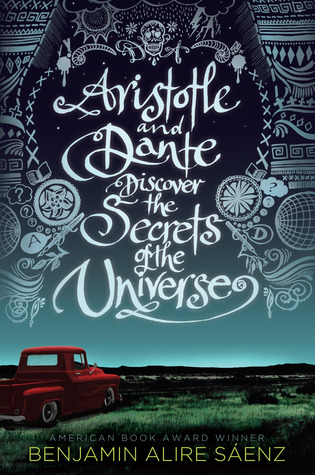
Aristotle and Dante Discover the Secrets of the Universe, Benjamin Alire Saenz

Aristotle and Dante Discover the Secrets of the UniverseOne summer night I fell asleep, hoping the world would be different when I woke. In the morning, when I opened my eyes, the world was the same. I threw off the sheets and lay there as the heat poured in through my open window.

"Aristotle is an angry teen with a brother in prison. Dante is a know-it-all who has an unusual way of looking at the world. When the two meet at the swimming pool, they seem to have nothing in common. But as the loners start spending time together, they discover that they share a special friendship—the kind that changes lives and lasts a lifetime. And it is through this friendship that Ari and Dante will learn the most important truths about themselves and the kind of people they want to be."

This was a very odd book, and I'm not sure that I liked it. It was certainly not what I was expecting. It almost seemed too angsty and too simplistic at the same time. I didn't really like the style or the main characters. Let's go with the good first: I really liked the beautiful cover and the premise of Aristotle and Dante Discover the Secrets of the Universe. I suppose it was a pretty sweet story, but it kind of just didn't work for me. I did like the way it was told though, with breaks and with Aristotle musing on life and his brother. Still, it felt kind of simplified to me, as if the author added all these issues that Ari and Dante have and then didn't flesh them out. For example, the fact that Ari’s brother is in prison. The author could have included more about that. I’m back to the bad. I guess I just didn't really like the book. I also didn't find the prose breathtaking. Not at all. The writing was kind of unremarkable, and as I said, felt kind of simplistic. It took me several days to read this relatively short book, mainly because I didn't feel like continuing to read. But it got a fair amount of acclaim, so I did want to finish the book. I can say now though that I don't think I'll be reading more of this author's work unless a book's plot sounds especially good. 

I also didn't enjoy the two main characters, both of whom did some pretty stupid things. I couldn't relate to them much or like them. A lot of their actions also didn't seem to fit them; for example, the way Ari is so obsessive about some things. I didn't like their friendship/romance either; it was kind of weird. I think it would have worked way better as just a friendship. There were also flat sections of the book where nothing of import seemed to happen, and some incidents that had no relation to the actual story.

I guess something I liked about the book is the fact that the author isn't afraid to take on difficult topics and talk about families who don't talk to one another enough. As I said earlier, it had a good premise; it just didn't develop enough for my taste and was way different from what I was expecting. I would have also liked to have read Dante's perspective a bit, although that wasn't a huge complaint of mine. My criticisms can basically be boiled down to one thing: it wasn't compelling or absorbing. 

Overall, Aristotle and Dante Discover the Secrets of the Universe was definitely a disappointment. I didn't like the characters, the writing, or the plot (although I did like the premise). It could have gone a whole other direction, but it didn't. And I didn't enjoy the book. Parts of it were so vague. I can't say I'd recommend it; if you must, check it out of the library (which thankfully is what I did).

359 pages. 

Rating: **

Saturday, October 5, 2013

The Lucy Variations, Sara Zarr

The Lucy VariationsTry harder, Lucy. Lucy stared down at Madame Temnikova's face. Which seemed incredibly gray. 

"Lucy Beck-Moreau once had a promising future as a concert pianist. The right people knew her name, her performances were booked months in advance, and her future seemed certain. That was all before she turned fourteen. Now, at sixteen, it's over. A death, and a betrayal, led her to walk away. That leaves her talented ten-year-old brother, Gus, to shoulder the full weight of the Beck-Moreau family expectations. Then Gus gets a new piano teacher who is young, kind, and interested in helping Lucy rekindle her love of piano -- on her own terms. But when you're used to performing for sold-out audiences and world-famous critics, can you ever learn to play just for yourself?"

I was in the mood for something light after reading Nothing to Envy, so I picked up Sara Zarr's latest novel at the library (I haven't read any of her other books). As it turned out, it wasn't actually so light; it's kind of unsettling, though obviously nothing compared to Nothing to Envy. The thing is, the family that Lucy lives in is so demanding; she's always supposed to be perfect, to be achieving, rather than having fun or enjoying life or seeing beauty. The pressure was so much that Lucy quit her piano playing, further disappointing her family. She felt like she didn't have a choice about anything, and it's true. But the thing is, Lucy is really good at piano. And she likes doing it, but not for the competition. Just for the sheer joy of music and creating something beautiful. 

Lucy's family was kind of scary, seemingly perfect: wealthy, loving, and all of that, but at the same time too demanding, chillingly demanding. They've basically stolen her childhood from her; ever since she started, she was expected to play phenomenally, to play good exhibition pieces. Although obviously The Lucy Variations is fiction, it was scary how realistic the Beck-Moreau family seemed. Lucy's mother and her grandfather are the main ones pushing her and her younger brother too hard, but her dad never seems willing to defend either of them. Perhaps it was a bit unrealistic, how cruel and unseeing they were, not seeming to want Lucy to actually be happy. Lucy's mom and grandfather kind of reminded me a bit of Wren's parents in The Infinite Moment of Us, although much worse. Her grandfather in particular was awful, but I felt sometimes that the way that Lucy acted was odd too, not bothering to show up to school on time a lot. There's a simple solution: get an alarm clock. Zarr does attempt to humanize Lucy's maternal side a bit, but their characterization was a bit low in terms of sympathy.

Lucy's family is pretty wealthy, and that adds to Lucy's sense that she's a brat or a bad person. She kind of takes certain luxuries for granted. It was interesting that rather than being a family of the idle rich, the Beck-Moreau's are the opposite, pushing their children to work, work, work. 

The Lucy Variations certainly wasn't a great novel, but it was, I suppose, interesting enough and a fairly quick read. It wasn't a super fun, mindless read though, because there are a lot of difficult elements. Still, it's kind worth reading and I'm glad I tried Sara Zarr. The third person narration was a bit odd; YA is mostly in first person, and I guess Zarr was trying to do something a little different. But it served to make The Lucy Variations more detached, as I understand that Zarr's other novels are all in the typical first person. It's true that I also get annoyed when so many young adult books are first person, present tense. I think my favorite style is probably first person, past tense; it's more immediate but not too much so.

Like John Green's novels, this is young adult contemporary, but I think books like The Lucy Variations are of an inferior quality to his books, which are gripping, enthralling, and at times heartbreaking. The Lucy Variations was none of those things; it had a lot of strong emotion on the part of the characters, but since it was narrated in third person, it didn't really make me feel anything strongly. The writing was rather unremarkable, although I do think Zarr captured really well the balance of happiness, fun, andsuccess needed to enjoy life and have a meaningful life. Perhaps the difference is that The Lucy Variations focuses pretty specifically on one specific issue, whereas John Green's books kind of don't. I don't know; I'm just speculating here. What do you guys think? But really, John Green is the best young adult author out there. There's no question in my mind. See, The Lucy Variations was good, but I don't think I'd ever feel like revisiting it or anything. Once was enough, whereas John Green's books I could read again and again (I'm actually planning to do a John Green (novel) Marathon in January). I'm not even sure that I'll want to pick up another Sara Zarr novel.

Still, The Lucy Variations wasn't bad, and it was good for a few hours of entertainment with some (but not much) thought. 

308 pages. 

Rating: 3.5 stars. 

Friday, October 4, 2013

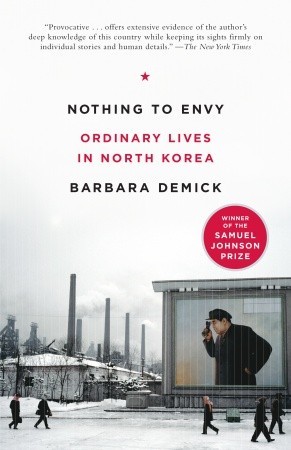
Nothing to Envy, Barbara Demick

Nothing to Envy: Ordinary Lives in North KoreaIf you look at a satellite photograph of the far East by night, you'll see a large splotch curiously lacking in light. This area of darkness is the Democratic People's Republic of Korea.

"Award-winning journalist Barbara Demick follows the lives of six North Korean citizens over fifteen years—a chaotic period that saw the death of Kim Il-sung, the rise to power of his son Kim Jong-il, and a devastating famine that killed one-fifth of the population. Demick brings to life what it means to be living under the most repressive totalitarian regime today—an Orwellian world that is by choice not connected to the Internet, where displays of affection are punished, informants are rewarded, and an offhand remark can send a person to the gulag for life. Demick takes us deep inside the country, beyond the reach of government censors, and through meticulous and sensitive reporting we see her subjects fall in love, raise families, nurture ambitions, and struggle for survival. One by one, we witness their profound, life-altering disillusionment with the government and their realization that, rather than providing them with lives of abundance, their country has betrayed them."

Nothing to Envy is a fascinating and very depressing book; I certainly learned a lot, but it's not an easy book to read. It tells of a country in the modern world devoid of the conveniences that most people have come to take for granted. North Korea is a place almost completely closed off from the rest of the globe; Demick's subject felt so alien to me. It's hard to imagine people living in circumstances like those in North Korea, without technology, without connection to other people in the twenty-first century. And yet the citizens of North Korea go about their lives just like everyone else. That spot of darkness on the satellite picture holds as many people as England, all of them struggling to survive. I didn't know the history of how Korea was split (so ignorant, I know), and Nothing to Envy tells us this too (of course).

The prison camps in North Korea have been compared to Nazi concentration camps by the few survivors who made it out. And that begs the question: why isn't the rest of the world doing something about it? Now it seems unimaginable that in the 30's and 40's the rest of the world stood by as the Nazis perpetrated horrible crimes. But similar things are happening in North Korea, and none of the Western countries seem all that interested in doing something about it (at least to my knowledge). We're all more worried about North Korea's nuclear problems. See an article here about the prison camps. (Also, The New York Time's review of Nothing to Envy here). When babies are born, they are slaves in the camp, people are tortured for the slightest slips, and they fight over the smallest crumbs, betraying one another without remorse. Now, this may all seem a bit sensational, but it's probably for the most part true. Demick also chillingly compares North Korea to the world of Orwell's 1984, in which the only color is that of the propaganda posters; the same thing is true in North Korea, where the rest of the landscape is devoid of bright colors. The title of the book also comes from one of the sayings on propaganda posters, "We have nothing to envy in the world", which is from a rhyme that children sing in school. They also have to sing a song about Yankee bastards and shooting them with "their own hands". And many North Koreans, like the first woman who Demick interviews, believed that. They didn't know that there were other places where life was much better. "Mi-ran" herself thought that most places had it worse, and that she was "lucky to have been born in North Korea under the loving care of the fatherly leader." It seems unimaginable to us that people could be so blind, but as Demick points out, ever since their infancy, they were deluged from every direction with films, TV programs, educational brainwashing, and advertisements, all portraying outsiders as evil and Kim Il-sung as a kind of God figure, his son like Jesus.

By the time I'd read half of the book, I was very depressed, to say the least of it. But I think books like Nothing to Envy are so necessary to read, as a reminder of how easy we have life, and how many people are suffering without much aid. I knew North Korea was bad, but I had no idea it was that bad. Nothing to Envy is grim, but important. It also tells people's personal stories, of people struggling to survive in the famine of the 90's which killed over 10% of the population, as well as of the sweeping facts. It was a great combination, and Demick writes with compassion and clarity, stating the facts but also showing her own emotions.

I was kind of tempted to put Nothing to Envy down several times, not because the book is bad but because the material is so disturbing, so disgusting. But that's exactly why one must read Nothing to Envy and books of its kind, to gain a better understanding. I can guarantee you that the majority of Americans are almost completely in ignorance of the situation. And that's not a good thing. Nothing to Envy is definitely a must read if you have any interest at all in the state of the world.

296 pages. 

Rating: ****

Thursday, October 3, 2013

Crewel, Gennifer Albin

Crewel (Crewel World, #1)I can count the days until summer draws to a close and autumn seeps into the leaves, painting them ginger and scarlet. Right now, though the dappled light of mid-afternoon is glorious emerald, and it's hot on my face. With sun soaking into me, everything is possible. 

"Incapable. Awkward. Artless.  That’s what the other girls whisper behind her back. But sixteen-year-old Adelice Lewys has a secret: She wants to fail.  Gifted with the ability to weave time with matter, she’s exactly what the Guild is looking for, and in the world of Arras, being chosen to work the looms is everything a girl could want. It means privilege, eternal beauty, and being something other than a secretary. It also means the power to manipulate the very fabric of reality. But if controlling what people eat, where they live, and how many children they have is the price of having it all, Adelice isn’t interested. Not that her feelings matter, because she slipped and used her hidden talent for a moment. Now she has one hour to eat her mom’s overcooked pot roast. One hour to listen to her sister’s academy gossip and laugh at her dad’s jokes. One hour to pretend everything’s okay. And one hour to escape. Because tonight, they’ll come for her."

Crewel certainly isn't a hugely creative science fiction novel as the book claims; it has all the usual dystopian elements of an authoritative government controlling who you marry, where you live, etc., but it does have some interesting aspects, most notably the description, something most fast-paced YA novels don't have because the author thinks the reader will lose interest. Not so here. I mean, the first paragraph is description, and so is the second. And while the writing wasn't great, I do admire Albin for trying to add a bit more to the novel rather than just sheer suspense. The main part of the plot is somewhat unique, but it's not really explained until later on: the Spinsters who weave time and manipulate reality. That was quite interesting and it originally drew me into the novel. Adelice's parents don't like the system, and they've trained her, despite her talent, to hide it. But she slips up, and is taken away to be a Spinster, a position all the other girls covet. The rebounding process that Adelice has to go through in particular was quite unique. I'd never read anything quite like it, with the threads of time being woven so that people can effectively travel without moving a muscle. Of course, there is another typical part to the plot; Adelice is different from all the other Spinsters, more powerful and dangerous than they are. 

What I didn't understand was why Adelice slipped so easily. There may be some small part of her that wants to, yes, but she knows that once she is chosen, she can't ever see her family again, and that she certainly doesn't want. Besides, Adelice's parents have trained her for years to hide the talent that she has, to be "incapable, awkward, artless." It didn't seem plausible that in one instant, she could forget all of that. For much of the book the reader also doesn't know exactly what happened at the Testing, just that Adelice messed up. Later it's kind of explained.

Parts of Crewel were definitely quite chilling, especially when Adelice first arrives at the compound, which is basically a web of illusions and fake windows.There’s also the fact that each person is represented by a thread, and these threads are altered and removed with mechanical precision. Calling people threads makes it sound less bad, and none of the other girls seem to question any of itThe compound sounded like an awful, awful place, where everyone looks perfect but is trapped forever to do the work of Arras and the Guild. Adelice also learns about the Creweler, the head organizer. She doesn't want to become one of these perfectly unsettling people, but she really doesn't have much of a choice. 

I found Adelice a little insensitive at times. For example, at the orientation, Adelice says, "I almost feel sorry that some of them have left everything they know and love behind to wind up as servants. Almost." This seemed a bit cruel to me, even if those girls did want to leave and are embracing their new lives. You'd think Adelice would have a bit more sympathy, especially since she loses her beloved family too.


I didn’t love Crewel though, mainly because of the romance, which predictably was a love triangle. Please, can we cool it with those? Apparently not, because there is one, and I really disliked it. The world that Gennifer Albin created was interesting enough without romance; that whole element could have been taken out or at least less emphasized. I was expecting it, but it was still disappointing. I did enjoy the world and the story though. I suppose Crewel is worth reading, but it got kind of muddled in the later sections, and I'm glad I checked it out of the library.

357 pages. 

Rating: 3.5 stars. 

Wednesday, October 2, 2013

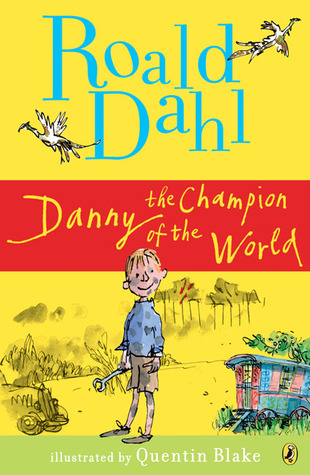
Rereading Danny the Champion of the World by Roald Dahl

Danny the Champion of the WorldWhen I was four months old, my mother died suddenly and my father was left to look after me all by himself. 

"Can Danny and his father outsmart the villainous Mr. Hazell? Danny has a life any boy would love—his home is a gypsy caravan, he's the youngest master car mechanic around, and his best friend is his dad, who never runs out of wonderful stories to tell. But one night Danny discovers a shocking secret that his father has kept hidden for years. Soon Danny finds himself the mastermind behind the most incredible plot ever attempted against nasty Victor Hazell, a wealthy landowner with a bad attitude. Can they pull it off? If so, Danny will truly be the champion of the world."

Danny the Champion of the World is certainly not one of Roald Dahl's most famous novels, and that's because it's not one of his best, but it is a fun read and does display Dahl's signature humor and quirkiness. It's not quite as grotesque as some of his other stories, but still pretty twisted in terms of how the villain of the story is characterized and what happens to him.

Even though I haven't read the book in a while, I still remembered the story really well; that always happens with Roald Dahl's children's books for me. Even if it's been several years, the plot is still fresh in my mind. I think this is the third time I've read Danny the Champion of the World though.  The plot is really weird, and certainly not as funny and entertaining as Matilda, James and the Giant Peach, or Charlie and the Chocolate Factory, Dahl's most famous works (a.k.a the ones adapted into well-known movies). 

You might say that this one is more powerful than the other of his books simply because it's less zany. You think more, rather than just being caught up in the weird twist and turns of a fantastical story. Danny has its improbable moments, but it's really a lot more realistic than Dahl's other children's books, most of which are downright fantasy. There are some pretty interesting quotes too. For example: "I was glad my father was an eye-smiler. It meant he never gave me a fake smile because it's impossible to make your eyes twinkle if you aren't feeling twinkly yourself. A mouth-smile is different. You can fake a mouth-smile any time you want, simply by moving your lips. I've also learned that a real mouth-smile always has an eye-smile to go with it. So watch out, I say, when someone smiles at you but his eyes stay the same. It's sure to be a phony." Also, "A stodgy parent is no fun at all. What a child wants and deserves is a parent who is SPARKY." Those were quite funny; Danny definitely has an amazing father. In the beginning of the book, before the action really occurs, Danny's father makes kites, fire balloons, bow and arrows, a tree-house, and special car-like thing for his son. To top it all off, he lives in a very small but amazing old gypsy caravan whose traveling days are over. A rather romanticized existence perhaps, but it still sounds pretty fun. 

There are some rather dubious morals in this book. After all, Danny's father is a poacher, and that's a thief. But it's the relationship between them that's so lovely to read about. And besides, in this case Mr. Hazell deserves to have his pheasants poached. He certainly needs to be taught a lesson, and what better way to do that than steal all of the birds in his wood before the shooting party? 

Danny is certainly not one of my favorite Roald Dahl novels, but I enjoyed rereading it, especially since I was in need of quick read. Roald Dahl's children's books are good for an afternoon of entertainment and humor. 

206 pages. 

Rating: **** 

Tuesday, October 1, 2013

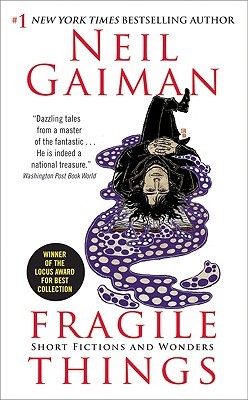
Fragile Things: Short Fictions and Wonders, Neil Gaiman

Fragile ThingsFrom "A Study in Emerald": It is the immensity, I believe. The hugeness of things below. The darkness of dreams. But I am woolgathering. Forgive me, I am not a literary man.

"A mysterious circus terrifies an audience for one extraordinary performance before disappearing into the night . . .Two teenage boys crash a party and meet the girls of their dreams--and nightmares . . .In a Hugo Award-winning story, a great detective must solve a most unsettling royal murder in a strangely altered Victorian England . . .These marvelous creations and more showcase the unparalleled invention and storytelling brilliance--and the terrifyingly dark and entertaining wit--of the incomparable Neil Gaiman. By turns delightful, disturbing, and diverting, "Fragile Things" is a gift of literary enchantment from one of the most original writers of our time."

I suppose I must have heard of Fragile Things before in the back of my mind, but I don't know why I didn't read it before. After all, it's Neil Gaiman, an amazing author, and it's a collection of fantasy short stories, which when done well, can be excellent. That said, I didn't really enjoy the first story, "A Study in Emerald", based of course on "A Study in Scarlet". Maybe it's because I haven't read the original story recently enough to get the subtle references to it, but I felt it didn't do the original justice or display Gaiman's genius. Some of the other stories were great, though, such as the third one, "October in the Chair", which is dedicated to Ray Bradbury and is indeed somewhat reminiscent of him. It was a great and entertaining story, with stories within stories. The premise was so great, and as he is wont to do, Gaiman gradually reveals more of it up until the end of the story, which contains more revelations. This happened in "A Study in Emerald", but less effectively, I think. The descriptions in "October in the Chair" of what the different months are like and of the fall scenery were great too, and I loved the ending so, so much, the way that Gaiman really brought this very good idea to life, although as he says in the introduction, Bradbury might have written it better. Still, he did a really good job. (Hint: Never listen to writers such as Neil Gaiman and John Green when they call a work of theirs bad. It's usually amazing, and then you feel envious, because if this is their bad stuff, what does their good stuff look like?)

I didn't like the verse style "stories", such as "The Fairy Reel" and "The Hidden Chamber", among a few others. The only poem I liked was "Instructions" (on what to do in a fairy tale); that was pretty funny and cool. I also enjoyed "The Forbidden Brides of the Faceless Slaves in the Secret House of the Night of Dread Desire." It exhibited another Gaiman trademark, that of turning the real world upside down, reversing everything. "A Study in Emerald" does this too, but here the stuff of 18th and 19th Gothic horror novels are reality, and the realm of fantasy is that of whole-wheat bread, cars, and computers. It was darkly humorous as well as silly, and though not one of Gaiman's best, very amusing. More brilliant and strange stories followed, and as in any short story collection, some of the stories were better than others. Overall, though, I loved the book, even though some of the stories were flops. I also really liked the background Gaiman gives about each of the stories in the introduction; it's worth reading, and there's a little surprise in it too. 

Something else I gleaned from reading Fragile Things is where Erin Morgenstern's inspiration for the structure and phrasing of her blog and her blurbs comes from. There were many phrases Gaiman used that Morgenstern has borrowed from him, "story-shaped" (she changes it to "novel-shaped") and "story-stuff" among them. The Night Circus definitely has Gaiman-esque elements to it as well. 

Anyway, I'm very glad I picked Fragile Things up. I'd say that The Ocean at the End of the Lane is still a better Gaiman work since some of these stories weren't to my liking, but it was an excellent collection full of "short fictions and wonders", which by the way seems like a phrase Erin Morgenstern might use. Gaiman has another earlier collection of short stories, Smoke and Mirrors, which I'll probably be checking out. Incidentally, it's subtitled "short fictions and illusions", which sounds intriguing.

339 pages. 

Rating: ****