Sunday, December 1, 2013

The Dinner, Herman Koch

The DinnerWe were going out to dinner. I won't say which restaurant, because next time it might be full of people who've come to see whether we're there. 

"A summer's evening in Amsterdam and two couples meet at a fashionable restaurant. Between mouthfuls of food and over the polite scrapings of cutlery, the conversation remains a gentle hum of polite discourse - the banality of work, the triviality of holidays. But behind the empty words, terrible things need to be said, and with every forced smile and every new course, the knives are being sharpened. Each couple has a fifteen year old son. The two boys are united by their accountability for a single horrific act; an act that has triggered a police investigation and shattered the comfortable insulated worlds of their families. As the dinner reaches its culinary climax, the conversation finally touches on their children, and as civility and friendship disintegrates, each couple show just how far they are prepared to go to protect those they love."

I really enjoyed The Dinner, and despite its being rather pretentious, it was darkly humorous and wonderfully sardonic. I practically bookmarked every page as having some little twist or irony of note, and wrote down a whole list of adjectives that could be used to describe this novel. There are certainly a lot.

I found myself inexorably drawn into this chilling story. The narration is one of annoyingly withholding information, which serves to make the book more suspenseful as well as foreboding. Because for about half of the book, there are hints of this dreadful event, but the reader doesn't actually know what it's all about. The tension builds and builds, and it's what's not being said that is important, in terms of Paul's narration and the dinner conversation. Herman Koch employs very detailed descriptions of the gourmet food, but he's so, so vague about the actually important things. There's also this building dread as the restaurant manager's pinky gets closer and closer to the food itself.

The Dinner wonderfully satirizes the whole gourmet food culture of the restaurant at which the dinner is held, from the descriptions of black-pinafored maitre-d's to the Art Deco lights, to the restaurant manager himself, endlessly describing the food that he serves. The whole scene is rather nightmarish actually, juxtaposed with what's actually going on at the dinner and in the characters' lives. The novel definitely does skewer the pretentious menus (pun alert). That said, the book itself is rather pretentious too, and one can tell that Herman Koch thinks he's remarkably clever. Which he is, but that's beside the point.

The Dinner certainly skewers more than just pretentious menus; it reveals the darker side of genteel society, and satirizes the certain brand of politician and supposed family man that the narrator's brother Serge represents. It also rather cynically poses an agonizing conundrum: how far will you go to protect the ones you love, even if they've done something unspeakable? And what is your devotion to the law? Such cases as these are never easy, and it's definitely really, really hard, more so in this case because it's the two brothers' sons who are involved.

The characters in this book are really unlikable, though I didn't hate them as much as others. Paul seemed okay, just arrogant and fond of mocking other people. At least so it appears at first. As the narrator, he sets the tone of the novel: sardonic, cynical, unsettling and more nasty by the page. As the book progressed, he gets really disturbing; Paul definitely has some psychological issues, such as when in a flashback he wants to pulverize the principal. At first, I kind of lauded him for his rejection of certain things, and he seemed sane and clearheaded enough; however, it becomes clear that he has many, many problems and is not altogether sane despite his affection for his wife and son and his marital bliss (before the incident, of course). By the end, Paul is revealed as a maniac. Babette, Serge's wife, was I think the least characterized; I didn't really get a sense of her enough to like or dislike her. Serge is of course, really annoying and pretentious and pedantic, but one can tell that Paul is perhaps a little too critical of him. These four people are meeting for a tense and charged night of...well, that's what the novel's about.

As one might expect, the very slow, stretched out nature, of the book leads to some issues in terms of plotting and pace but it's remarkably well done. There are often many pages in which Paul dwells on one particular characteristic or reflection, but that's part of the book's dark charm and humor. There are of course flashbacks to days and weeks previous, which make the story much more interesting. And since Paul is so coy about what the dinner is actually being held to discuss, it kept me reading. The Dinner is subtle and methodical, slyly portraying and revealing human rituals and often their ridiculousness.

 The Dinner is quite disturbing, what with the heavy foreshadowing of doom that is woven throughout the book. Koch also plays with a refrain from Anna Karenina: the very first line about happy families all being alike and unhappy families all being unhappy in their own way. Paul keeps hinting that his family's happiness is over, about to devolve into a unique form of unhappiness.

I'll end with a quote from the very beginning of the novel that is quite chilling and basically provides the set-up or lead-in to the rest of the book: "It happened quickly: one moment I was looking at Claire, looking at my wife, probably with a loving gaze, or at least with a twinkle, and the next moment I felt a damp film slide down over my eyes. Under no circumstances was she to notice anything strange about me, so I buried my face in her hair. I tightened my grip around her waist and sniffed: shampoo. Shampoo and something else, something warm - the smell of happiness, I thought.What would this evening have been like if, no more than an hour ago, I had simply waited downstairs until it was time to go, rather than climb the stairs to Michel's room? What would the rest of our lives have been like? Would the smell of happiness I inhaled from my wife's hair still have smelled only like happiness, and not, as it did now, like some distant memory - like the smell of something you could lose just like that?" (pgs 15-16).

Read another excellent review here.

292 pages.

Rating: ****

Thursday, November 28, 2013

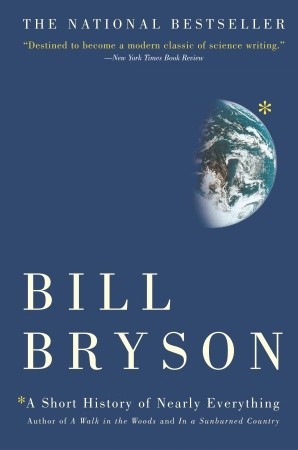
A Short History of Nearly Everything, Bill Bryson

A Short History of Nearly EverythingWelcome. And congratulations. I am delighted that you could make it. Getting here wasn't easy, I know. In fact, I suspect it was a little tougher than you realize. 

"In Bryson's biggest book, he confronts his greatest challenge: to understand -- and, if possible, answer -- the oldest, biggest questions we have posed about the universe and ourselves. Taking as territory everything from the Big Bang to the rise of civilization, Bryson seeks to understand how we got from there being nothing at all to there being us. To that end, he has attached himself to a host of the world’s most advanced (and often obsessed) archaeologists, anthropologists, and mathematicians, travelling to their offices, laboratories, and field camps. He has read (or tried to read) their books, pestered them with questions, apprenticed himself to their powerful minds. A Short History of Nearly Everything is the record of this quest, and it is a sometimes profound, sometimes funny, and always supremely clear and entertaining adventure in the realms of human knowledge, as only Bill Bryson can render it. Science has never been more involving or entertaining."

Of course, this book isn't really a history of "nearly everything", but it sure is an entertaining and absorbing account of the universe's beginnings, and how we as humans have come to partly understand the unfathomably large and wondrous world around us. A Short History of Nearly Everything is such a fascinating book, mainly because the universe is such a fascinating place. There are so many statistics, so many facts, that are nearly impossible for the human brain to comprehend. The universe's age, for example, and how it got to be that way. In the very beginning of the book, Bryson discusses the fact that what became the universe was once smaller than a proton. But to us it seems obvious that there must have been something around that little space. There couldn't just be nothing. But of course there was nothing. It's paradoxes like these that intrigue me and many others and that Bryson attempts to explain to the layman in this book.

As he points out, there are a lot of questions that we feel like we ought to know the answer to, and feel ashamed of actually asking. There are so many things that I use and take for granted that I know very little about; it's scary how unknowledgeable I am about computers, the Internet, and cars, to name a few examples. Of course, that's not what Bryson delves into here, but it's scientific things like that. His questions are more like how scientists "figure things out...how does anybody know how much the Earth weighs or how old its rocks are or what really is way down there in the center? How can they know how and when the universe started and what it was like when it did? How do they know what goes on inside an atom? And how, come to that - or perhaps above all - can scientists so often seem to know nearly everything but then still can't predict an earthquake or even tell you whether we should take an umbrella with us to the races next Wednesday?" That's from the introduction; I normally skip introductions but this one just drew me in with Bryson's signature humor.

That said, one does get tired of Bryson's humor after a little while; he can be rather smug, and you can tell that he knows he's funny. The problem, I think, is that the style never varies throughout the book, which is what sometimes frustrates me about some nonfiction books. In fiction, the style changes as the story does, but that doesn't really happen here. I realize that it's a science book, but I would still like a bit more variation. After all, Bryson is telling a story of sorts - the story of the universe. Bryson thinks he's so amusing, and that's a drawback that I've found in many of his books (although I haven't read any in a while). Still, it must be said that he is very funny, and he knows how to draw one in very well, whether he's writing about the Big Bang or a hike on the Appalachian trail.

Another unfortunate drawback to this book is that although it was published in 2004, it's already very outdated. There may be many instances of this, but the one that I noticed was that Bryson still referred to Pluto as a planet, when it has since been declared not one. I found it kind of ironic that after 9 years the book's information is a bit out of date, but the earth is billions of years old and 9 years is just an unimaginably small fraction of that. It just shows you how fast scientific research is progressing. I also think that despite the fact that if the history of the universe was squeezed into one year humans would not emerge until late in December 31, it is a mistake to completely devalue our existence. After all, humans have been around for a couple million years, and that's a lot, even if it's nothing compared to the whole timespan. And you know what? We've accomplished a lot of great and a lot of terrible things in the time we've been here. That said, it's important to remember that we're not as important as we'd like to believe: laughably insignificant, in fact. Still, viewed on a smaller scale, we're a lot of lives.

In A Short History of Nearly Everything, Bill Bryson certainly does cover a lot of different sciences and their histories. He talks about the world's beginnings, about other solar systems, biology, astronomy, paleontology, physics, chemistry, and all of the other disciplines that led people to begin to piece together the history of the world. All of it is fascinating; I simply can't understand those people who aren't interested in the universe, and in the planet we have the good fortune to live on. Really, the fact that any of us are alive at all is miraculous, and we ought to be sensible of that. First of all, if not for just the right combinations, life would have never started on Earth at all. Then, we had to evolve into a human species, and all the genetic combinations had to be just right. It's flabbergasting if you really think about it.

Bryson discusses the entirely likely probability that there might be life somewhere in the vast universe, but that we'll probably never make contact with them because we're just too far away. He talks about the murky area in the 18th and 19th centuries between chemistry and alchemy, and about the sometimes vicious rivalries and enmities between scientists of the time, in their race to discover new things, be it dinosaur bones or certain theories. Bryson also states that by the end of the 19th century "many wise people believed that there was nothing much left for science to do", which is very interesting and kind of funny because obviously there was a lot more for science to do. This is also good to keep in mind because now in the 21st century, it's easy to assume that we've "discovered" everything, when of course that's not true in the slightest.

All in all, this is a thoroughly fascinating and humorous account of how the universe came to be the way it is. The humor may get old after a while, but I was never bored by this book.

478 pages.

Rating: ****

Wednesday, November 27, 2013

Unremarried Widow, Artis Henderson

Unremarried WidowMy husband Miles dreamed of his death in the fall of 2005, nine months before he deployed to Iraq. He was twenty-three years old. 

"A world traveler, Artis Henderson dreamed of living abroad after college and one day becoming a writer. Marrying a conservative Texan soldier and being an Army wife was never in her plan. Nor was the devastating helicopter crash that took his life soon after their marriage. On November 6, 2006, the Apache helicopter carrying Artis’s husband Miles crashed in Iraq, leaving her—in official military terms—an “unremarried widow.” She was twenty-six years old. In Unremarried Widow, Artis gracefully and fearlessly traces the arduous process of rebuilding her life after this loss, from the dark hours following the military notification to the first fumbling attempts at new love. She recounts the bond that led her and Miles to start a life together, even in the face of unexpected challenges, and offers a compassionate critique of the difficulties of military life. In one of the book's most unexpected elements, Artis reveals how Miles’s death mirrored her own father’s—in a plane crash that she survived when she was five. In her journey through devastation and heartbreak, Artis is able to reach a new understanding with her widowed mother and together they find solace in their shared loss."

I certainly wasn't expecting anything great from Unremarried Widow, and it wasn't, despite the bold claims on the back of the ARC, which I won via Goodreads. However, it was surprisingly good in its way, though nothing earth-shattering. I enjoyed the understated writing style and the way the author didn't try to make the book into much more than her rather moving story. I mean, there's plenty of reflection, but she's not trying to say anything about Life or Death, instead focusing on a smaller scale. She connected both the death of her father in a plane accident and the death of her husband very well, alternating between the two, although I would have liked a bit more of that as the book progressed. The only real scene that talks mainly about her father is towards the beginning. There's a lot of narration before Miles actually dies while in Iraq, and we know what's coming, so that was actually used really effectively to build sympathy as this man is introduced and characterized, all the while knowing that he's going to die, that in fact that death is the whole premise of the memoir. I actually found Miles to be kind of selfish at times, but the narrator clearly loved him very much. The thing was, she had to sacrifice a lot of what she wanted to do when she became his partner/wife, and that annoyed me. 

I did enjoy the way that Artis Henderson used little anecdotes and snippets of life to recount her story and illustrate her points, rather than going more chronologically through the events of her life with Miles. As she puts it writing about something else, the book is composed of "just stories, brief peeks into the experience, like peering through a window..." Although that's not what she was referring to, I thought it fit the narrative style pretty well. It was also quite straightforward, and I liked that aspect. 


What I didn't like was the vaguely religious aspect, the psychic that Artis goes to several times who seems to know everything about her life and what's going to happen in it. There's also this talk of spiritual connection or whatever, and I certainly don't buy into that. Sorry. I have a feeling that here the narration isn't quite accurate. Especially the letter from Miles before he died seemed somewhat constructed, although it's certainly possible. At any rate, what Artis Henderson has crafted is pretty moving in its own way, although I certainly didn't cry and cry as the editor says she did on the back of the ARC. It's not really that kind of book; I was totally dry-eyed. Admittedly, I'm not the crying type in books, but I didn't even feel the temptation to cry as I sometimes do.

There are some sexist elements to the book to, such as when Artis visits Mile's parents' ranch, where "he rode horses and worked the ranch with his father while I stayed inside with Terry." Who gives Artis a bunch of recipes (sigh). That was just me being nit-picky though, because obviously there's nothing wrong with baking.

Anyway, Unremarried Widow wasn't great or anything, but it certainly was interesting enough, and provided some insights into the army way of life. It also shows you just what a waste the Iraq war was, costing the lives of countless young men like Miles Henderson. Anyway, the book doesn't come out until early January, but keep your eyes out for it until then. I would recommend the library.

240 pages.

Rating: 3.5 stars.

Friday, November 22, 2013

The Amaranth Enchantment, Julie Berry

The Amaranth EnchantmentI was sweeping the shop when a glimmer between two floorboards caught my eye. A penny? I knelt for a closer look.

"Lucinda Chapdelaine was orphaned as a young child when her parents left for a royal ball and never returned. Ever since, she has toiled away in her uncle's lonely jewelry shop under the cruel hand of her step-aunt. But now, all at once, Lucinda's lot is about to change. A mysterious woman, a handsome young gentleman, and an unusual gem all enter the shop on the very same day. The woman is none other than the dreaded Amaranth Witch, and she has a daring task to offer. If Lucinda succeeds, she will not only reclaim all that is rightfully hers, but she will a discover a true friend...and perhaps a true love. Family secret, magical surprises, and another royal ball will test her, but Lucinda is determined to find her own happily ever after."

The Amaranth Enchantment is an unremarkable but fun and entertaining fairy tale. I picked it up at my school library, and it's worth a read if you're a fan of fairy tale-esque stories, which I am. It was very reminiscent at least in some respects of other middle grade fairy tale/fantasy novels such as The Runaway Princess and one other one I've read but whose name I'm blanking on.

In this case, the beginning of the book was much better than the ending. At first, the novel felt really atmospheric, and I was thoroughly enjoying it. The Amaranth Enchantment is set in the real world, historically, except that it also has magic, and there are other worlds that can be reached through wells (that was kind of weird). I feel like the adding of countless other worlds just made the book way more complex, and it wasn't fleshed out properly. I did enjoy the main character though, and some of the secondary characters too. The plot itself isn't that interesting, but follows the same mold as many fairy tale retellings; it's vaguely like Cinderella. Lucinda is from a wealthy family and she's taken in by her cruel aunt who abuses her horribly. Then she meets a prince, completes a quest...you get the idea. All very well and good, but nothing special.

I found the book entertaining, breezy, and quick, and I did like it; it just wasn't structured very well. There was never really a climax, and what could have passed for a climax was just quick and rushed. Overall if you were to draw out the book's progression it would just be a bunch of small waves, rather confusing actually. The book's not action-packed, that's for sure.

Beryl or the amaranth witch was a really odd character, at least to me. She kind of randomly appeared, and so did the prince for that matter, coincidentally showing up at the shop on the same day and turning Lucinda's life upside down. This stretched belief just a little bit; "Beryl" as a name also wasn't very good. It was hardly fitting for someone from a different world with intense magical powers.

Overall the book was very predictable except for one twist at the end that I was totally not expecting. It was good as a fantasy novel, but the world didn't particularly interest me, nor would I ever see myself rereading this book or reading a sequel. I would skip it, although there's nothing particularly bad about The Amaranth Enchantment; it just had some issues in terms of plotting and wasn't very suspenseful or memorable. In other words, it was rather bland.

320 pages.

Rating: ***

Thursday, November 21, 2013

More Than This, Patrick Ness

More Than ThisHere is the boy, drowning. In these last moments, it's not the water that's finally done for him; it's the cold. 

"A boy named Seth drowns, desperate and alone in his final moments, losing his life as the pounding sea claims him. But then he wakes. He is naked, thirsty, starving. But alive. How is that possible? He remembers dying, his bones breaking, his skull dashed upon the rocks. So how is he here? And where is this place? It looks like the suburban English town where he lived as a child, before an unthinkable tragedy happened and his family moved to America. But the neighborhood around his old house is overgrown, covered in dust, and completely abandoned. What’s going on? And why is it that whenever he closes his eyes, he falls prey to vivid, agonizing memories that seem more real than the world around him? Seth begins a search for answers, hoping that he might not be alone, that this might not be the hell he fears it to be, that there might be more than just this. . ."

The only other Patrick Ness book I've read is A Monster Calls, and I did like it (although I didn't love it). More Than This, however, was simply mindblowing. To be honest, I'm still not quite sure what to make of it, and have a feeling that this review will be rather discombobulated. It did not help that Blogger deleted half of my review as I was typing it.

Anyway, I really was sucked into this terrifying and disturbing novel as soon as I began to read. It feels so real and immediate, and the pace is so fast-paced, making for a really intense novel. One can almost feel the characters' pain, whether it's physical or emotional. The very first scene, that of the drowning, is one example of the physical pain; it was quite difficult to read, as was the subsequent awakening, and Seth discovering that he's still alive, albeit in a really strange world. 

Those who think young adult fiction is all junky should read this book. I'm not saying it's great or that it'll be remembered necessarily (although you know never know), but More Than This is still really intelligent, and it certainly purports to be something more than mindless entertainment. It's edgy and provocative, and it left me pondering when I wasn't reading it and after I'd finished it. Just when you think you know what's going on, everything changes, the world is turned upside down again. Patrick Ness plays with certain genres of apocalyptic fiction and dystopia that are way overused in YA and tweaks them, tries to do something new. The result is a scary, absorbing, and brilliant novel.

As I said, More Than This was really frightening, at least to me. I don't particularly enjoy reading scary books, and this was borderline, but I enjoyed nonetheless. It just sucked me in. The scary part is really how unknown everything is to Seth, this strange place that he wakes up in. Also, almost every section brings new revelations, spine-tingling ones. Both the physical and the emotional are frightening in this book, from the opening with Seth drowning to all the terrible things that happened to him.

More Than This is also really strange and hard to comprehend. There are like two different worlds, but you're never sure which one is "real" or if any of them are real at all. Ness takes the typical apocalyptic-dystopia set-up, with humans relying more and more on technology, and the real world a doomed wasteland, and turns it sideways, changing little things here and there. 

The book is also really grim; both Seth's recollections and the place he's in now are pretty bleak. There are flashes of dark humor now and then, but that's about it. 

I didn't love the ending; it felt a little too ambiguous, and although it was clever, I would have liked something more. Overall, though, I ended up really enjoying this creepy and absorbing novel. I wasn't expecting it to be so intense, that's for sure. I received a review copy from Candlewick, and I'm so glad that I requested it. 

472 pages.

Rating: ****

Wednesday, November 20, 2013

Rereading The Curious Incident of the Dog in the Night-Time by Mark Haddon

The Curious Incident of the Dog in the Night-Time
It was 7 minutes after midnight. The dog was lying on the grass in the middle of the lawn in front of Mrs. Shears's house. Its eyes were closed. It looked as if it was running on its side, the way dogs run when they think they are chasing a cat in a dream. But the dog was not running or asleep. The dog was dead.

"Christopher John Francis Boone knows all the countries of the world and their capitals and every prime number up to 7,057. He relates well to animals but has no understanding of human emotions. He cannot stand to be touched. And he detests the color yellow. Although gifted with a superbly logical brain, fifteen-year-old Christopher is autistic and everyday interactions and admonishments have little meaning for him. He lives on patterns, rules, and a diagram kept in his pocket. Then one day, a neighbor's dog, Wellington, is killed and his carefully constructive universe is threatened. Christopher sets out to solve the murder in the style of his favorite (logical) detective, Sherlock Holmes."

I read The Curious Incident... quite a while ago, and remembered enjoying it, though also thinking it was really weird and not loving it. I reread it again for a book club, and was glad that I did so, although I still think that it's a pretty odd book and not necessarily my cup of tea, at least in general. However, it is thought-provoking enough, and is one of those books that challenges your assumptions about people and about life. I don't have that much to say about The Curious Incident of the Dog in the Night-Time, but here goes nothing. 

Christopher is certainly a fascinating character, a mix of contradictions. He is so, so intelligent, with extensive math and science knowledge, yet he is completely nonplussed when it comes to anything social. He doesn't know how to chat with people, he can't really process emotions and expressions very well, he doesn't know when to, you know, not say things, and he talks rather brazenly about certain taboo subjects in polite conversations.

The most interesting thing about this book is the portrayal of how Christopher views the world so differently from everyone else. He cannot stand the color yellow, and yellow cars lined up in a row means that it will be a bad day. Red cars, however, are good; the more the better. This was particularly interesting because it seems pretty irrational, but when someone says that to Christopher, he points out that generally people will be in a better mood when it's sunny as opposed to if it's rainy, even if they work inside an office where weather has no effect on how their day goes. That made me stop and think for a moment; Christopher's cars and the weather affecting mood are both, I suppose, kind of just overall omens or talismans. We need to make sense of the world somehow and form patterns.

My main problem with the book is that it's rather simplistic at times, and the way of narrating is slightly annoying. Like, the vast majority of the sentences start with "and", as in: "And he said...And I said...and then I..." The whole book isn't like that, but there are some sections that are, and I wasn't fond of it. I appreciate what Haddon was trying to do there, but it got monotonous after a while. I'm also not sure how well this actually portrays an autistic person's experience. I realize there are many forms of autism, on many ends of the spectrum, so this is probably not much like most autistic kids (although some perhaps). The author did work with autistic children, so he probably has experience.

Something I did find interesting was how both of Christopher's parents struggle with raising him and with their lives. They fight, and they threaten, and they swear, but still manage to be for the most part sympathetic characters. Still, there were definitely times when I disliked them. I do like how they're realistic people; it must be so, so hard to raise an autistic yet highly gifted child like Christopher, and they struggle to do so. Christopher's parents are two great characters.

I wasn't overall fond of the ending; it was rather inconclusive, and didn't tie the story up very well. I'm fine with ambiguous endings, but this was more just...sudden, and it didn't fit the type of book that this is. I liked The Curious Incident okay, but it's certainly not one of my favorite books or on that I'll be rereading anytime soon. The story itself is very interesting, but the writing, at least for me, left much to be desired.

221 pages.

Rating: ***

Tuesday, November 19, 2013

Rereading Of Mice and Men by John Steinbeck

Of Mice and MenA few miles south of Soledad, the Salinas River drops in close to the hillside bank and runs deep and green. The water is warm too, for it has slipped twinkling over the yellow sands in the sunlight before reaching the narrow pool.

"They are an unlikely pair: George is "small and quick and dark of face"; Lennie, a man of tremendous size, has the mind of a young child. Yet they have formed a "family," clinging together in the face of loneliness and alienation. Laborers in California's dusty vegetable fields, they hustle work when they can, living a hand-to-mouth existence. For George and Lennie have a plan: to own an acre of land and a shack they can call their own. When they land jobs on a ranch in the Salinas Valley, the fulfillment of their dream seems to be within their grasp. But even George cannot guard Lennie from the provocations of a flirtatious woman, nor predict the consequences of Lennie's unswerving obedience to the things George taught him."

I first read Of Mice and Men a while ago when I was eight or nine, and I remembered liking it but not much else. Rereading it now, for school, I once again rediscovered its brilliance, its beauty, and its deep sadness. I wish I'd reread it sooner, because of Of Mice and Men is a great, great book. Who says short books can't be just as expressive and meaningful? Not I. There are so many brilliant aspects of this book, aspects that I probably didn't catch on to the first time I read it, and aspects that I still probably haven't fully realized that will be explored in the class I'm taking. The constant refrains, for example: "livin' on the fatta the lan'." And the rabbits, the rabbits that Lennie wants so desperately to tend, that he dreams of tending. Right from the start, you know it's doomed; the novel takes place south of Soledad, south of solitude, south of loneliness.

Lennie and George are two very interesting characters, almost opposites, really. Lennie is described in animal like terms quite often, as "dabbling a big paw" while drinking. He has the power to crush a man's hand in his fist, he breaks mice by petting them. Yet he never means any harm; all the bad things that he does are by accident, because he didn't know what else to do. George, on the other hand, is small and dark and very, very sharp; he knows how to survive, and often tells Lennie that if not for him, he would be doing much better. You know, however, that George doesn't really mean it, that there's such a strong bond between the two of them, even if George does get cross at Lennie sometimes because of all the bad things that he does.

You can tell from reading his work that Steinbeck fiercely loves both California's landscape and its people, its wanderers and dreamers. At the beginning of several of the chapters, there are long, detailed descriptions of the woods and the brush, and the creatures living in them. The style here is very accurate, in sharp contrast to the way the characters speak, which is quite ungrammatical, to say the least. The descriptions are beautiful, and they at least partially serve to contrast the beauty of the landscape and the ugliness of what occurs in it, on both the human and animal scale, with their similarities and differences.

Of Mice and Men is both a highly absorbing and really, really fast read. I probably finished it in about forty-five minutes worth of time, and I seem to recall reading it that quickly the first time I read it too. Of course, in this case, I'm going to go back over it again and again, but initially the pages fly by really quickly. It's also not one of those books you feel like you have to rush through, because it's quick anyway, and you can glean a lot from the novel even reading it in a short span of time. I certainly felt like I did.

Steinbeck builds dread so, so well. There are many scenes in which which the tension builds and builds (Lennie is, of course, oblivious to it all), until I could hardly bear it. Many of these scenes are with Curley, but some are with other characters as well (like Crooks). And of course, there's the scene with Lennie and Curley's wife, which just kills you (and others). I find it rather interesting that she's never given a name, just "Curley's wife", a possession described rather cheaply. There's lots of foreshadowing of the terrible, final event what with Lennie's fondness for soft things and how he often "breaks" them. Also dread-inducing.

The friendship between George and Lennie is portrayed so well, written both with fierceness and tenderness. It endures until the heartbreaking end, when George realizes what he must do, in a scene that is both powerful and deeply moving. Despite Of Mice and Men's short length, Steinbeck manages to convey so, so much about friendship and human nature and the characters' desire, their yearning, for roots, for their own little patch of land to care for and call their own. This is really at the heart of the novel. I would highly recommend Of Mice and Men. I may add to this review later once it is discussed in my English class; we'll see.

118 pages.

Rating: *****