The first thing I remember tasting and then wanting to taste again is the grayish-pink fuzz my grandmother skimmed from a spitting kettle of strawberry jam. I suppose I was about four.
"In 1929, a newly
married M.F.K. Fisher said goodbye to a milquetoast American culinary
upbringing and sailed with her husband to Dijon, where she tasted real
French cooking for the first time. The Gastronomical Me is a
chronicle of her passionate embrace of a whole new way of eating,
drinking, and celebrating the senses. As she recounts memorable meals
shared with an assortment of eccentric and fascinating characters, set
against a backdrop of mounting pre-war tensions, we witness the
formation not only of her taste but of her character and her prodigious
talent."
I'm still not sure what I think of this book; it's so strange and the mood quite puzzling. I enjoyed the writing, I suppose, but I'm still unclear as to what the goal of the book was. There aren't any specific recipes, so it's basically just a chronicle of Fisher's gastronomic adventures, starting from her early childhood and eventually moving on to France (Djon).
I picked up The Gastronomical Me while browsing; I love food and reading mouthwatering food descriptions, and I had also heard the book described as being brilliant and about so much more than food.
The Gastronomical Me is a puzzling book. I liked certain aspects of it, but others just confused me. It's just so odd, and all those "pre-war tensions" didn't make much sense to me. I guess Fisher just assumes that the reader knows what her situation is; for example, she and her second husband (?) are living in this idyllic location, and these people come to visit her, people who she presumably doesn't know. Yet Fisher doesn't say anywhere that she's running a boarding house or something like that. I guess my complaints about this book don't make much sense either; it just...bothered me in certain parts. In fact, I'm not even sure that "Chexbres" was her second husband; in the first part of the book, she's living in Djon with her husband Al; then she recounts a voyage with the man she's falling in love with, and then suddenly Al is completely out of the picture and she's living with Chexbres. Poor Al. I certainly don't mind making inferences, but the gaps in her narration were just too much. I suppose the focus was on the food, but also on the people she eats it with, and if you're going to write a memoir, you should be fairly clear. This wasn't.
I actually put aside this book and started reading The Patron Saint of Liars; I wasn't quite ready to give up on it altogether, but I definitely needed a break.
It's quirky, to be sure, but I didn't end up finishing this book, which is populated by eccentric characters, memoir-style narration, and descriptions of food. It all sounds very good, but the execution was just not to my taste (see what I did there?)
272 pages.
DNF.
Wednesday, January 15, 2014
Monday, January 13, 2014
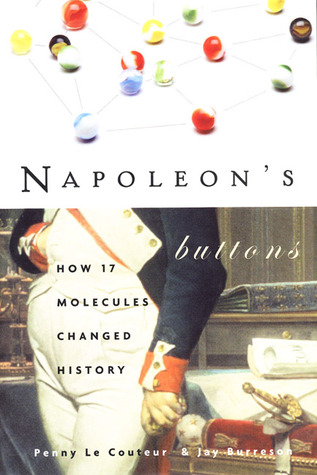
Napoleon's Buttons: How 17 Molecules Changed History by Penny Lecouteur & Jay Burreson
In June 1812, Napoleon's army was 600,000 strong. By early December, however, the once proud Grande Armee numbered fewer than 10,000. "Though many factors have been proposed to explain the failure of Napoleon's 1812 Russian campaign, it has also been linked to something as small as a button-a tin button, the kind that fastened everything from the greatcoats of Napoleon's officers to the trousers of his foot soldiers. When temperatures drop below 56°F, tin crumbles into powder. Were the soldiers of the Grande Armée acutee fatally weakened by cold because the buttons of their uniforms fell apart? How different our world might be if tin did not disintegrate at low temperatures and the French had continued their eastward expansion! This fascinating book tells the stories of seventeen molecules that, like the tin of those buttons, greatly influenced the course of history. These molecules provided the impetus for early exploration and made possible the ensuing voyages of discovery. They resulted in grand feats of engineering and spurred advances in medicine; lie behind changes in gender roles, in law, and in the environment; and have determined what we today eat, drink, and wear."
This book is both original and fascinating; I'm quite sorry that I didn't dive into it sooner. I was quickly absorbed by this refreshing mix of science and history; I learned a lot of both and read this book quite quickly for a science book. There was also the added fact that I had to return it.
I would have liked a little more detail in terms of the historical side of things and a little less chemically; however, that was just my preference. Napoleon's Buttons certainly does go fairly in-depth chemistry-wise, showing the exact formations of many of the substances discussed and how they differ from others. I have to admit that a lot of it went over my head, and I was more interested in the historical detail and how in general the substances affected or could have affected history.
It's kind of obvious that science and the advance of history go hand-in-hand; after all, progress is fueled by new inventions, which are generally scientific, but this book really goes in-depth into certain aspects of this relationship. Although I haven't read Guns, Germs, and Steel, in some ways it seems to me that the authors here are doing something similar, analyzing and interpreting history through unexpected ways. In fact, many things relating to guns (weapons), germs (germ treatment), and steel (development of new materials) have their own sections in this book. The seventeen sections deal with spices (peppers, nutmeg, and cloves); ascorbic acid; glucose; cellulose; nitro compounds; silk and nylon; phenol; isoprene; dyes; "wonder drugs"; the pill; "molecules of witchcraft"; morphine, nicootine and caffeine; oleic acid; salt; chlorocarbon compounds; and "molecules versus malaria". Yet there was no chapter on the title: how Napoleon's soldier's buttons were made out of tin and thus did not fare well in the harsh Russian winter. That was very puzzling, and annoying. Still, I suppose there's not that much more to explain in that case.
I actually found the chapter on the birth control pill quite illuminating. It was interesting both historically and scientifically, and I learned a bit about how it actually works. Many of the other sections were fascinating too; it's stunning to think about the fact that many of the materials and technologies we take for granted today took a long time to develop and perfect. As the authors so astutely point out, without rubber, without dyes, without antibiotics, without many molecules, modern society as we know it wouldn't exist at all.
I'll admit to skimming some of the detailed drawings and diagrams of how the molecules are structured; I just wasn't that interested or in the mood for a detailed chemistry lesson. However, I'm definitely considering getting my own copy of this book so that I can read it more slowly.
Napoleon's Buttons is well-written as well, and I read it fairly quickly for a science book. There are other science books that I've enjoyed more, but this one was still very good.
354 pages.
Rating: ****
Saturday, January 11, 2014
Rebel Heart, Moira Young (Spoilers)
It's late afternoon. Since morning, the trail's been following a line of light towers. That is, the iron remains of what used to be light towers, way back in Wrecker days, time out of mind. It winds through faded, folded hills, burnt grass and prickle bush. "There is a price on Saba’s head. She brought down a ruthless tyrant and saved her kidnapped brother. But winning has come at a terrible cost. Saba is haunted by her past—and a new enemy is on the rise, an enemy who searches for her across the Dust Lands. Saba needs Jack: his moonlit eyes, his reckless courage, his wild heart. But Jack has left. And her brother is haunted by ghosts of his own. Then news comes that tells her Jack can never be trusted again. Deceived and betrayed, haunted and hunted, Saba will need all of her warrior’s strength just to survive. For the enemy has cunning plans of his own…"
Rebel Heart isn't quite as good as Blood Red Road, but I enjoyed it nonetheless. It has some excellent new characters and developments, and is certainly just as absorbing and suspenseful as the first book. Young really creates great tension between the characters in an unknown, scarred wasteland. They're all hoping for better places ahead.
I loved the subtle and not so subtle nods to Of Mice and Men in Rebel Heart. At one point Lugh is telling the oft-repeated story of what it's going to be like at the Big Water (much like George repeatedly painting a picture of the farm for Lennie). He says that "there's rabbits everywhere at the Big Water. As far as the eye can see, nuthin but rabbits. You cain't move fer trippin over 'em. An you ain't never seen ones like these fellas". He goes on to add that they're juicy and tender and just waiting to be cooked. So obviously Of Mice and Men; the book also has a similar dialect to the one used in Steinbeck's great novel. There's also that pervasive feeling of hope, that things have got to get better.
Just like Tris in Insurgent, Saba is haunted by her actions, reliving again and again her shooting of her friend Epona. It's really startlingly similar; Tris shoots Will, Saba shoots Epona. She must come to terms with this and all of the other lives, good and bad, that she's taken. That said, Saba does a lot of really stupid things, thoughtlessly putting herself and her friends in jeopardy. It was hard to read her motivations. And Lugh's even worse. He's nasty and cruel to Saba, and several times I downright hated him. I would have liked to see more of a balance in their relationship; obviously, it couldn't be restored to what it was before, but instead they were almost constantly snapping and fighting with one another.
WARNING: Minor spoilers ahead. Proceed at your own peril.
And then there's Jack. Oh, Jack. We meet him at the very beginning, and then not again, until Maev shows up saying that he's joined the Ton Ton. Saba doesn't believe it, but then it's confirmed. Truth be told, I wasn't sure where that plot-line was going to end up, although I had read the summary for the third book. And then something totally unexpected happened with DeMalo, and then I was just confused. That wasn't bad though; the book just captured my interest even more towards the end. I raced towards the finish...and then something awful happened; there were thirty or so pages missing from my paperback edition! Just as I reached the climax of the novel. What a grievous printer's error. I managed to read the majority of the missing pages on Amazon, but not all, and I didn't get to read the death of a pivotal character, for which I'm sorry. It was so disappointing; I'll try and get another copy.
The whole angle with DeMalo was out of the blue, as was Tommo. I actually liked it, though it's definitely worrying. That plot-line certainly had the effect of making me really excited for the last book, Raging Star. If you loved Blood Red Road, I would certainly recommend Rebel Heart. I'm sorry I didn't read it sooner.
424 pages.
Rating: ****
Thursday, January 9, 2014
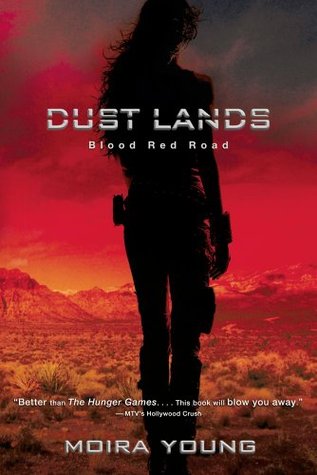
Rereading Blood Red Road by Moira Young
The day's hot. So hot an so dry that all I can taste in my mouth is
dust. The kinda white heat day when you can hear th'earth crack."Saba's world is shattered when her twin brother, Lugh, is captured by four cloaked horsemen. Determined to rescue him, Saba sets off into the lawless, wasted landscape left behind by the Wreckers. It's a brutal world where Saba discovers some surprising things about herself: She's a fierce fighter, a cunning opponent, and above all, an unbeatable survivor. Teamed up with a handsome daredevil named Jack and a gang of girl warriors called the Free Hawks, Saba is off to save her brother - and maybe her whole world."
I first read the marvelous Blood Red Road a little less than two years ago, and loved it. The sequel, Rebel Heart, finally came out in paperback a few weeks ago (I wanted to have matching editions), so I figured it was time to reread the first book. I didn't remember much about it except that I'd loved it.
There are so many marvelous elements to this novel: it's incredibly suspenseful and moving, the world is compelling, and there are lots of wonderful characters. Each part is excellent in its own way, and the portrayal of Hopetown is particularly a chilling, a place where everyone is driven only by a drug called chaal that causes them to be really bloodthirsty.
Blood Red Road is full of suspense. Much like the first time, I raced through the book so quickly, not wanting to put it down despite knowing a lot of what would happen. The book is a little hard to get into because of the dialect, but after a few pages, I did, and then I was hooked. So don't let that turn you off; the dialect ends up being really effective in characterizing both Saba and the people around her, enhancing both the relationship between Saba, Lugh, and the other characters as well as the raw grief Saba feels during various parts of the novel.
It's all set in a really fascinating world. It's not developed a whole lot, but hopefully some of the backstory will be filled in in later books. Nevertheless, the stark, scarred desert landscape is the perfect backdrop for an epic fight between good and evil. At times, the characters refer to "the Wreckers", presumably us, who had flying machines and all sorts of gadgets and ultimately ended up destroying much of the world. Education is also a thing of the past; books are regarded by some as rare objects, and not many people have the skill of reading. Like others, Saba doesn't even know what books are until she is shown one by Rooster Pinch.
There's so much adventure in this novel, but it can also be really
moving. Young shows the strong bond between Saba and Lugh really well in only a
few pages before he is snatched away. In her view, he's the light, she's the dark, always following him, in his shadow. This makes Saba pursuing him and the
riders who take him really realistic. Saba is a great character; she's tough
and wants to be independent. At times, she's really nasty to Emmi, but I love
how that relationship progresses. And she clearly loves her brother so much.
One feels for her, but Saba's character development is great. At times she does something really kind or thoughtful, but that doesn't mean she's suddenly become a perfect person, which is quite realistic.
The other characters are also amazing: Emmi, Jack, and of course the intrepid Free Hawks, a band of girls and women who roam the countryside. They're great, and so is Nero, Saba's pet crow, with near-human intelligence and a knack for showing up at just the right moments. I also in spite of myself love the romance in this book; there's no love triangle, and Jack is a great character.
Blood Red Road is a well written, thrilling young adult dystopia/post-apocalyptic novel with a great plot and ending. Rebel Heart, here I come!
459 pages.
Rating: *****
Tuesday, January 7, 2014
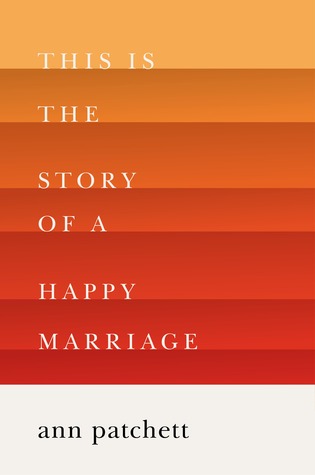
This is the Story of a Happy Marriage, Ann Patchett
The tricky thing about being a writer, or about being any kind of artist, is that in addition to making art you also have to make a living."Blending literature and memoir, Ann Patchett, author of State of Wonder, Run, and Bel Canto, examines her deepest commitments—to writing, family, friends, dogs, books, and her husband—creating a resonant portrait of a life in This is the Story of a Happy Marriage.This Is the Story of a Happy Marriage takes us into the very real world of Ann Patchett’s life. Stretching from her childhood to the present day, from a disastrous early marriage to a later happy one, it covers a multitude of topics, including relationships with family and friends, and charts the hard work and joy of writing, and the unexpected thrill of opening a bookstore."
I certainly enjoyed this collection from Ann Patchett; of her novels, I've read State of Wonder, Bel Canto, and The Magician's Assistant, and am now thinking of reading her first novel, The Patron Saint of Liars. I'd never read any of her essays before, and some of them were quite good, offering wise advice and moving stories alike. I was under the impression that these were all new essays; however, most of them had been published previously in various magazines. That was okay though, because they were all new to me.
"The Getaway Car" was one of the lengthiest essays in this collection, and it had a lot of good writing tips in it, such as just practicing and practicing and writing a lot, even if most of it is junk. I haven't been writing much fiction lately, and I should. This essay also details her own writing experience from her education, mainly in writing short stories, to working as a waitress, to finally starting a novel. And then she never went back to short stories. I enjoyed it, although there did seem to be some extraneous parts.
Some sections of this book are quite moving, and many of Patchett's comparisons rang true, when she was talking about art and writing. She begins, for example, "The tricky thing about being a writer, or about being any kind of artist, is that in addition to making art you also have to make a living. My short stories and novels have always filled my life with meaning, but, at least in the first decade of my career, they were no more capable of supporting me than my dog was. But part of what I love about both novels and dogs is that they are so beautifully oblivious to economic concerns. We serve them, and in return they thrive. It isn't their responsibility to figure out where the rent is coming from." Patchett devotes an essay, "This Dog's Life", to her relationship with her dog Rose. It was quite touching, and in some respects reminded me of some of E.B. White's essays, though it was less humorous. They do seem to have a similar tone in their essay writing though, which I found quite interesting.
The following essay, "The Best Seat in the House" is about Patchett's passion for opera, and being a fan as well, I found myself nodding and smiling in recognition of familiar references. For some strange reason Ann Patchett lives in Nashville, and her solution is to go to the Met HD broadcasts. I've been to a few myself, and they're quite good; however, there's something about being their, live, for the performance, that the HD lacks. The 3D, and perhaps being able to look wherever you want and seeing the broader picture. Of course, the live HD screening has its advantages; it's cheap, it's convenient, and you get clear close-ups you wouldn't normally. I'd still rather go to the live opera though.
Much like the reviewer for The New York Times, I didn't take many notes while I was reading; I was just absorbed by the prose and the stories. Looking back, though many of the essays, especially, the later ones, were wonderful.
There's a short essay about Patchett's home, Tennessee, which I found quite evocative with its portrayal of the countryside, expanding surburbia, and how modernity brings lots of change, some good and some bad. A lot of the beautiful rural areas are being turned into hideous apartment buildings, but as Patchett shrewdly points out, the Klu Klux Klan no longer marches through the streets periodically.
Another one that I enjoyed was "The Wall", about Patchett's experience of taking the entrance exams for the LA Police Department, even though she didn't actually want to become a policewoman; it was more for her writing purposes and because her father had been a policeman. She writes about a whole world of extreme fitness that we don't normally see, and about the camaraderie that exists between policemen and women.
There's an essay about book tours, "My Life in Sales"; I found some sections of it amusing: "You know when the interviewer hasn't read the book because the first question is always, 'Let's talk about this really great cover.'" Patchett also writes that "once the book is written, its value is for the reader to decide, not for me to explain." I think she's exactly right. I know in my English class there's all this focus on what the author intended, what the author is trying to portray. And sure, that's important, but more so is what we as readers get out of a book, maybe something that the author never even thought about.
One of my favorites of all the essays was "The Love Between Two Women Is Not Normal". In 2006, Clemson University assigned one of Patchett's books, Truth and Beauty, to all the incoming freshman. Truth and Beauty is a nonfiction book, about the deep friendship between Patchett and the writer Lucy Grealy, who suffered from severe jaw cancer that left her face permanently disfigured. It was also about her death. Anyway, predictably enough, some parents tried to get the book banned because it contained "pornography". Book banning just infuriates me, especially when there's no justification whatsoever. This isn't even high school; these are college students! I'm pretty sure they're going to think about everything they read, and not going to rush off to do whatever the book contains in it. I found this essay quite compelling, as was the transcript of her address to the Clemson students, where she basically use the same arguments above fleshed out, and then some. I was definitely in agreement with Ann Patchett's views.
"Love Sustained" was one of the sadder essays, about Patchett's grandmother's gradual decline and ultimate death. It was followed by "The Bookstore Strikes Back", about the founding of an independent bookstore in Nashville after its two bookstores went out of business. I have to say, that I've never really wanted to go to Nashville, but I wouldn't mind visiting Parnassus Books now. It seems like a good bookstore, founded on good principles. There's also a lovely picture of the bookstore on the back cover, and it looks quite enticing.
The title essay was marvelous as well. I couldn't relate it to it much, but nevertheless I was absorbed and engrossed and very moved. Some of Patchett's actions seemed a bit unfathomable to me, but I'm sure they made sense to her. It wasn't my favorite, but it was still excellent.
My one criticism is the narrative style; most of the essays are written in the present tense, and I found that a little awkward. Maybe that's why they reminded me a little bit of E.B. White? I also know that Patchett loved Charlotte's Web as a child.
Anyway, I really enjoyed this collection of essays; it's definitely worthwhile, and each essay has its points. Read another review here; there are a lot of points in that review that echo my sentiments. I received a review copy from Harper.
306 pages.
Rating: ****
Monday, January 6, 2014
The Luminaries, Eleanor Catton
The twelve men congregated in the smoking room of the Crown Hotel gave the impression of a party accidentally met."It is 1866, and young Walter Moody has come to make his fortune upon the New Zealand goldfields. On the stormy night of his arrival, he stumbles across a tense gathering of twelve local men who have men in secret to discuss a series of unexplained events: A wealthy man has vanished, a prostitute has tried to end her life, and an enormous fortune has been discovered in the home of a luckless drunk. Moody is soon drawn into the mystery: a network of fates and fortunes that is as complex and exquisitely ornate as the night sky."
The Luminaries is quite an intriguing novel; it has many aspects of a typical Victorian pastiche while also trying to do something original. The book is trademark Dickens/Wilkie Collins, fiendishly plotted, with all sorts of mysteries within mysteries and depths to plumb. The most unique aspect of this Booker Prize winning novel is of course that the story is plotted around the astrological symbols, with twelve local men each representing one of them. I think, however, that this part was completely unnecessary; not being familiar with the astrological symbols myself, it didn't add anything to the characterization. The novel would have been just as good, if not better, without it.
The Luminaries is full of long asides and reflections, both on the characters' part and the narrator's. There's a lot of backtracking and switching of perspectives as the plot is developed more and more. I like that style, although of course it is rather infuriating because one wants to know what's going to happen next immediately. There were stories within stories; one character started off, and then different characters took up the thread, going back and retracing to the present. This is very much to do with the idea of cyclical returnings and the town's name, Hokitika, which according to the Maori character in the novel means something to do with returning; "place of return", perhaps.
The complexity of this novel is just astonishing. There are so many different threads of narrative, and they're woven together so skillfully. Eleanor Catton also creates these absurdly complicated situations where some of the characters are trying to conceal certain things from some of the others, but want to tell those same things to other people in the room. There are many roundabout, evasive conversations in this book too, with no saying what they really mean and deliberately leaving parts of the story out. There are all these secrets, and everyone seems to have a little piece to the puzzle. I was never quite sure where this novel was going. Additionally, everyone seems to have some tenuous connection to events, and there are so many "coincidences" that occur.
There's so much mystery in this novel in a Dickensian manner, full of all the best elements of a dense Victorian mystery. There are secrets, strange happenings, and many, many complications. Also in the vein of Dickens, there are compelling descriptions of the filth, squalor, and poverty of Hokitika, a town quite literally springing up from nowhere because of gold in the surrounding area. In general, there's so much fascinating description in The Luminaries. Is it too much in places? Yes. But I suppose one has to expect that. Many reflections on the characters' parts also populate this book, and some of them are quite interesting. The very omniscient narrator sometimes interjects as well, and I kept feeling like the narrator was snidely making choices about what to tell the reader. .
There are many different themes woven throughout the novel. One is a sort duality and parallelism between characters and situations (an example among many is the stories of Moody and Crosbie Wells, which seem in some respects to mirror one another). The stars are also key in this, although as I mentioned earlier, not an element I loved. There's also the one stemming from the name of the town, that everything is circular and will return to itself eventually; this too permeates the novel.
Each major section is half as short as the previous one; the first is over three hundred pages, and the last (the twelfth, of course) is barely two pages. Within parts, the smaller chapters too generally get shorter, so that by the time one reaches the end of this behemoth novel, the 19th century style "in which this-and-this happens" descriptions are longer than the chapters themselves. I'll admit that this is a really clever literary trick, and it made me chuckle, but to a certain extent it felt rather gimmicky. Still, I have to admire Eleanor Catton's skill with words.
There's even a courthouse scene in this book; I love reading those. In this case, Moody is the defending lawyer of the side we're presumably sympathetic to, and it was very gratifying.
Nothing is as it seems in The Luminaries, and the situation is always changing, what with so many factors and so many secrets. The Luminaries is certainly skillfully written, although it is very dense and took me a fairly long time to read. One might also say that the novel lacks focus at times, but overall it was well plotted and executed. I would recommend it if you're up for a challenge. I received a review copy from Little, Brown.
830 pages.
Rating: ****
Sunday, January 5, 2014
New Year's Resolutions Of Sorts
I think we all know that New Year's resolutions are overrated; after all, the beginning of a new year is completely arbitrary, and I could just as well do this in February for Chinese New Year, but nevertheless, I have some bookish related resolutions:
1. Read less. I know this seems counter-intuitive; but I guess I don't mean read less, I mean read more slowly, take more time. I'm a really fast reader, and I feel like sometimes I'm rushing to finish and review books so that I can keep up the volume of posts, and that's not good. When I slow down, I always notice so much more.
2. Read better. MG YA fiction is all very well, but this year I want to read more literature and more nonfiction. Rest assured, I'll still be reading children's and teen books from my favorite authors, but probably less of it. There are so many young adult and middle grade novels coming out that look good and I'm sure would be entertaining, but are just sort of a waste of time for me. Reading biography, history, science, and classic literature is much more worthwhile. Sometimes, though, you just need a break, you know? And that's when I turn to YA or really well written middle grade.
3. Read longer: Les Miserables, here I come! War and Peace, watch out! This goes along with both #1 and #2. If I want to post every day or almost every day, I can't read Hugo and Tolstoy; instead I have to read shorter books. Which means that I probably won't be posting quite as much this year. There's also the fact that I have lots of other activities that I want to devote time to. If only we could freeze the clock...
4. Review better. Since I'm going to read less books, I can review each of those books more in-depth, right? At least I hope so. We'll see.
5. Start participating in those book blogging things: Not sure what to call them, but I want to start doing Top Ten Tuesday, and other things like that. Hopefully it will garner more traffic as well, though that's just an added bonus.
So, this year and perhaps years after you can expect less posting, but hopefully better reviews of better books and other posts. Looking forward to it. Happy New Year, all!
1. Read less. I know this seems counter-intuitive; but I guess I don't mean read less, I mean read more slowly, take more time. I'm a really fast reader, and I feel like sometimes I'm rushing to finish and review books so that I can keep up the volume of posts, and that's not good. When I slow down, I always notice so much more.
2. Read better. MG YA fiction is all very well, but this year I want to read more literature and more nonfiction. Rest assured, I'll still be reading children's and teen books from my favorite authors, but probably less of it. There are so many young adult and middle grade novels coming out that look good and I'm sure would be entertaining, but are just sort of a waste of time for me. Reading biography, history, science, and classic literature is much more worthwhile. Sometimes, though, you just need a break, you know? And that's when I turn to YA or really well written middle grade.
3. Read longer: Les Miserables, here I come! War and Peace, watch out! This goes along with both #1 and #2. If I want to post every day or almost every day, I can't read Hugo and Tolstoy; instead I have to read shorter books. Which means that I probably won't be posting quite as much this year. There's also the fact that I have lots of other activities that I want to devote time to. If only we could freeze the clock...
4. Review better. Since I'm going to read less books, I can review each of those books more in-depth, right? At least I hope so. We'll see.
5. Start participating in those book blogging things: Not sure what to call them, but I want to start doing Top Ten Tuesday, and other things like that. Hopefully it will garner more traffic as well, though that's just an added bonus.
So, this year and perhaps years after you can expect less posting, but hopefully better reviews of better books and other posts. Looking forward to it. Happy New Year, all!
Subscribe to:
Posts (Atom)