Monday, October 14, 2013

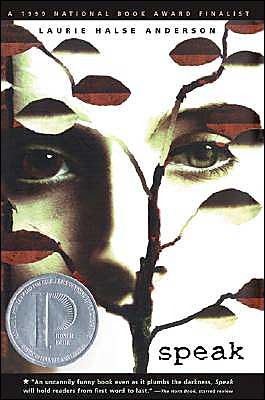
Speak, Laurie Halse Anderson

SpeakIt is my first morning of high school. I have seven new notebooks, a skirt I hate, and a stomachache. 

"Melinda Sordino busted an end-of-summer party by calling the cops. Now her old friends won't talk to her, and people she doesn't even know hate her from a distance. The safest place to be is alone, inside her own head. But even that's not safe. Because there's something she's trying not to think about, something about the night of the party that, if she let it in, would blow her carefully constructed disguise to smithereens. And then she would have to speak the truth. This extraordinary first novel has captured the imaginations of teenagers and adults across the country."

I really enjoyed Speak. It's a compelling and moving novel. I can't believe I hadn't read it before. The book is pretty short and a quick read in terms of length, but let me tell you, it's a hard book. It's really depressing, because Melinda is just so depressed throughout the novel. She's basically just shut down in an attempt to forget what happened to her, rather than trying to speak about it, or move past it, or explain to her former friends why exactly she called the police. I was a bit frustrated by this, and sometimes it was hard to relate to the way she acted, but I really have no idea how someone in Melinda's situation would feel. This novel is an attempt to explain both that, and why certain people act the way they do. 

I have to say though, that I'm in high school right now, and the high school Melinda goes to is nothing like mine. There may be cliques, but in general people are actually pretty nice, at least to me. People may not be all that intelligent, but most of them don't go out of their way to be viciously mean. And there's nothing like the Martha club, a group that purports to do good, but is actually competitive, vicious, and really nasty. I don't know if high schools like this actually exist, but the portrayal was very alien to me. In fact, it's the way books like this portray high school that made me super nervous before I started. But that's another story. 

The way Anderson writes is amazing, and she's not afraid to tackle a tough topic and direct it towards teens. Melinda's reaction is probably not what most people do, but it is the most extreme, and ultimately the most dangerous way: just shutting down, and refusing to speak. But, God, the book sad. The way Melinda didn't care about anything anymore, the way her parents didn't seem to notice that something was seriously wrong with her. You can tell by her voice that she's actually really smart, observant, and bitingly witty, but she's failing her classes, and all her parents can do is be mad at her, rather than stopping to wonder why their daughter is doing so badly. This was really frustrating too. Also, the way Rachel, Melinda's former best friend, completely shuts her out without bothering to talk to her didn't seem very realistic. After going through so much together in middle school, Rachel just hates Melinda without hearing her side of the story first? That was an element of the book that was a bit odd to me.

Some people have tried to ban Speak, and that just makes me furious. Yes, it talks about a difficult topic (rape), but it's something that needs to be talked about. You can't just ignore it and hope that things will get better, because they won't. I'm not saying Speak is going to change the world or anything (although some of Anderson's readers have writen to her about how she saved their lives), but I am saying that it's part of the battle. Also, I just hate it when people think teenagers are too stupid to be able to analyze something, that just because a book talks about rape, it will be seen as a book advocating rape. And that's just ridiculous. Anyone who has the mental capability to read Speak will certainly have the analytical capability of taking away from the book, if nothing else, that rape is bad and hurtful and just plain awful (although I would hope that most people knew that already. The sad thing is some people don't). Plus, the scene isn't actually graphic. At all. Here's one of the threads with people responding to the guy who wanted to ban the book. Go check it out. There were a lot of great responses. 

Anyway, Speak doesn't take that long to read, but it's a difficult book to read because of its subject matter. I would definitely recommend it though, and it was really moving, especially Melinda's slow regeneration process through art and other things, like a tree growing out of a small seed of hope. 

198 pages. 

Rating: ****

Sunday, October 13, 2013

The Berlin Boxing Club, Robert Sharenow

The Berlin Boxing ClubAs Herr Boch finished the last lecture of the school year, I sketched one final caricature of him into the margins of my notebook.

"Fourteen-year-old Karl Stern has never thought of himself as a Jew. But to the bullies at his school in Naziera Berlin, it doesn't matter that Karl has never set foot in a synagogue or that his family doesn't practice religion. Demoralized by relentless attacks on a heritage he doesn't accept as his own, Karl longs to prove his worth to everyone around him. So when Max Schmeling, champion boxer and German national hero, makes a deal with Karl's father to give Karl boxing lessons, Karl sees it as the perfect chance to reinvent himself. A skilled cartoonist, Karl has never had an interest in boxing, but as Max becomes the mentor Karl never had, Karl soon finds both his boxing skills and his art flourishing. But when Nazi violence against Jews escalates, Karl must take on a new role: protector of his family. Karl longs to ask his new mentor for help, but with Max's fame growing, he is forced to associate with Hitler and other Nazi elites, leaving Karl to wonder where his hero's sympathies truly lie. Can Karl balance his dream of boxing greatness with his obligation to keep his family out of harm's way?"

I'd had this novel in the back of my mind for a while, but I finally checked out a copy of it from my school library, which has quickly become a great source of books. I wish I'd read it sooner; while it's not as heartbreaking and emotional as other YA World War II books like Code Name Verity and The Book Thief, it had its points and was definitely very entertaining. I learned about a whole new world too: that of the German boxing scene which the unlikely Karl Stern becomes part of. You wouldn't normally think of him as a fighter; when the book opens he's really skinny, and dreams of becoming an artist. He also gets beaten up at school despite the fact that his family doesn't practice Judaism at all.

I really enjoyed the characters in this book, as well as the historical detail (I love World War II fiction). The plot conceit was also really interesting and kind of unique too; it shifts the focus a little to talk about something that no other World War II novel I've read talks about. Admittedly, I'm not that interested in boxing, and I take Greta's view on it, but I still enjoyed reading Karl's story and reading about the details of the boxing ring and the club where Karl trains. Sharenow added a lot of nice details, and I read The Berlin Boxing Club fairly quickly. It wasn't suspenseful, exactly; more like you just got drawn in, and didn't realize how quickly you were reading. And that was an excellent part of the book. 

Some parts of the book were really moving, especially the way Karl reacts to the bullying of his more obviously Jewish neighbors, particularly Mr. Greenberg. He channels his anger into the boxing, and it helps him get better and better at his new passion. It's certainly better than trying to pick a fight, which would get him and his family into a lot of trouble. 

Despite my lack of interest in boxing, I found the sections pertaining to the boxing very interesting and insightful. It's an excellent new angle to take, and an interesting way for people to channel their natural aggression and anger. I also thought it was kind of ironic that Jews at the time right before World War II and before the big restrictions were allowed to box, to fight. Meanwhile, shops were being vandalized, and people tormented in the streets. 

Maybe The Berlin Boxing Club wasn't quite as raw as The Book Thief or Code Name Verity, but nevertheless certain sections of it were still really sad. Right after Karl's first real boxing match, something very bad happens, and the way it was written wasn't over-dramatized, but it still felt really real, the conflict between Karl's parents, who have different strategies and ideas of what to do in a tough situation like the one they're in.  Other parts of the book too really rung true to me, and overall, The Berlin Boxing Club was pretty well written and plotted. I ended up really enjoying it, though it's certainly not as good as the other two  young adult World War II novels I've mentioned in this review. It's still worth reading though, whether you're interested in boxing or not. I call it a World War II novel, but all of the actions actually take place before the war breaks out; still, it's very much centered on World War II.

400 pages. 

Rating: ****

Saturday, October 12, 2013

Shine, Lauren Myracle

ShinePatrick's house was a ghost. Dust coated the windows, the petunias in the flower boxes bowed their heads, and spiderwebs clotted the eaves of the porch. Once I might have marveled at the webs - how delicate they were, how intricate - but today I saw ghastly silk ropes. Nooses for sawflies and katydids and anything guileless enough to be ensnared. 

"When Patrick Truman is found beaten, bound, and left for dead, sixteen-year-old loner Cat is determined to discover the truth of what happened to her former best friend. The local sheriff blames out-of-towners, but Cat is sure someone in their small, tightly knit Southern community is guilty of the crime. Patrick is gay, and for years he has been teased and bullied by people claiming to be his friends, people Cat calls "the redneck posse." She plans to start her hunt for the culprit with them. But there are two problems. Cat's brother is a member of the posse, and so is the boy who assaulted Cat years ago, forcing her into the self-imposed exile from which she must now emerge...for Patrick and for herself. Against a backdrop of poverty, clannishness, and intolerance, Myracle has crafted a searing coming-of-age story, couched in a compelling page-turner of a mystery."

At first, I wasn't sure if I was going to like Shine, because of a multitude of things including its bad font. Shallow, I know, but as I mentioned in my review of The Apothecary, sometimes it really makes a difference. In this case, though, I got used to it and was able to enjoy this moving and disturbing read. There were so many sad things in this book: the homophobia of the small town, the venomous sweetness of the townspeople, and most particularly the way Cat has drawn in on herself, dropping all of her friends, including Patrick. I enjoyed the portrayal of the town Cat lives in, although I can't help but wonder if towns like the ones portrayed in books as varied as Shine and Beautiful Creatures actually exist. After all, they seem kind of cliched. Still, Lauren Myracle was born in North Carolina, so I suppose she would know. It's also just sad that places like this probably still exist, although I did love the way Myracle wrote the book in terms of diction, with the ungrammatical phrases and everything (although Cat is more educated and speaks grammatically).

Shine is also really suspenseful, a "compelling page-turner of a mystery" as well as being a "searing coming-of-age story" (a pretty accurate description). Many parts of the book are also really gripping, in terms of plot and characterization. Speaking of which, the characters are also pretty compelling, particularly Cat's brother Christian and his buddy "Beef". Both of them have huge problems, yet they genuinely seem to care about Cat in their own ways. And she knows her brother enough to believe that he has nothing to do with the crime. The others of the "redneck posse" she's not so sure about. Especially Tommy, who she despises, and for good reason.

Sometimes the world in these books feels so alien to me, and I'm very lucky in that respect. Myracle's characters are poor and seemingly helpless. Myracle's portrayal of Gwennie, Beef's younger sister, was particularly striking in that respect. She used to confide in Cat about her problems and her father's mistreatment of her until Cat retreated into her self-enforced solitude. Now, Cat is forced to come out of the hole she's dug for herself and interact with the people who have hurt her and the people who she's hurt, like Gwennie, like Patrick. She really does hurt him, and I couldn't understand her actions a whole lot, but I do know that the whole episode with the bright orange pants was written so insightfully. It was quite sad, the beginning of the end, if you will.

There was a lot of discussion of Cat's emotions, of her feelings of inadequacy and short-coming. The scene in the library was also really well done. Cat pushes down her anger and retaliates towards the jerk who insulted her. Shine was just basically composed of moments that rang true, like the incident with the pants, like the scene in the library. That's what made it a really great book, and a super absorbing read. It was hard for me to put down. There is religion in the novel, but it's not too prevalent or that annoying; it's just part of the book and who Cat is. And the title comes from Mama Sweetie, saying that people can cast off their darkness and shine again. It was a beautiful line, if a bit cliched..

There were so many great scenes in Shine, and overall, I really enjoyed the way it was told and Myracle's lovely writing. I'm glad I finally got to read it, and it's certainly worth it.

350 pages.

Rating: ****

Friday, October 11, 2013

The Apothecary, Maile Meloy

The ApothecaryI was seven and living in Los Angeles when Japan surrendered at the end of World War II, and my first vivid memories are of how excited and happy everyone was. 

"It's 1952 and the Scott family has just moved from Los Angeles to London. Here, fourteen-year-old Janie meets a mysterious apothecary and his son, Benjamin Burrows - a fascinating boy who's not afraid to stand up to authority and dreams of becoming a spy. When Benjamin's father is kidnapped, Janie and Benjamin must uncover the secrets of the apothecary's sacred book, the Pharmacopoeia, in order to find him, all while keeping it out of the hands of their enemies - Russian spies in possession of nuclear weapons. Discovering and testing potions they never believed could exist, Janie and Benjamin embark on a dangerous race to save the apothecary and prevent impending disaster. Together with Ian Schoenherr's breathtaking illustrations, this is a truly stunning package from cover to cover."

I really enjoyed The Apothecary; it was an excellent middle grade novel that drew me in almost immediately, with beautiful prose and descriptions, as well as gorgeous illustrations to accompany the text. It didn't really feel like a middle grade novel though; it was more young adult, and the narrator (for once) felt mature for her age, fourteen. I liked that, actually, as I find middle grade fiction too simplistic sometimes. I was pleasantly surprised; it's a book with all the best elements: magic, a mysterious old book, a rebel, historical detail, an intelligent narrator, beautiful illustrations and atmosphere, and a move to a strange new place (in this case, England). There was a lot of great stuff, and plus, I really loved the font. It's weird, but if a book has nice looking font then I just enjoy it so much more. 

The writing drew me in, and the story was a really great and creative one. I loved Janie, who actually felt like a fourteen year old rather than someone younger. That happens a lot, particularly when I read middle grade books. The narrator feels way too young (like in A Mango Shaped Space) and that makes me enjoy the book less. In this case, I loved Janie and how she copes with all the strange, new things in her life. She's highly intelligent, witty, and conscious of the world around her. The story and writing were also richly atmospheric, with the black and white illustrations and talk of apothecaries. And anti-Communism; the reason Janie's parents move to England is subtle accusations of Communism back in America. Not a period I'm particularly proud of, but this is the first children's book I've read that mentions it at all.

The fantasy element of The Apothecary doesn't come in until later; at first it just seems like a fun historical fiction novel. But I knew the magic was coming having read the summary, and obviously because the cover reads "a dose of magic can save the world." Plus, Janie's had the weird feeling of being followed ever since the beginning of the book, and it's not just the agents who suspect her parents of Communism; it's something much more sinister. Exactly what, I was eager to find out. The real mysteries begin when Benjamin's father is kidnapped, but not before leaving his precious book, the Pharmacopoeia, to Benjamin and Janie. The story definitely picks up after that, but overall the pace is pretty slow, and I liked that. There was a lot of great magic too, with people turning into birds, muting spells, and truth spells. Plus espionage.

Side-note: Why does middle grade fiction always get amazing covers? Most middle grade books have covers that are at least passable, and many that are lovely and fit the book perfectly, whether they're wacky, mysterious, creepy, or just beautiful. Sure there are some decent and even really nice YA covers out there (like the gorgeous Chaos of Stars), but there are so many that feature hideously perfect models (Requiem) and covers that practically stamp them as "junky teen fiction" or some variant of that. The genre does itself a kind of disservice, I think. Middle grade covers actually have nice illustrations and covers, attempting to actually attract readers. And I know, there's the old adage "don't judge a book by its cover", but let's face it: everyone does to some extent. There are so many books out there, and sometimes one has to judge a book based on the cover and a quick peek at the plot summary.

Anyway, that didn't have a whole lot to do with The Apothecary, except that it's a middle grade novel with a pretty nice cover. The story is really good too. I would recommend The Apothecary for those looking for a smart read where the narrator actually seems like her age. I'm looking forward to reading the sequel when it comes out in paperback.

353 pages. 

Rating: ****

Thursday, October 10, 2013

Fortunately, the Milk, Neil Gaiman

Fortunately, the MilkThere was only orange juice in the fridge. Nothing else that you could put on cereal, unless you think that ketchup or mayonnaise or pickle juice would be nice on your Toastios, which I do not, and neither did my little sister, although she has eaten some pretty weird things in her day, like mushrooms in chocolate. "No milk," said my sister.

"'I bought the milk,' said my father. 'I walked out of the corner shop, and heard a noise like this: T h u m m t h u m m. I looked up and saw a huge silver disc hovering in the air above Marshall Road.' 'Hullo, I said to myself. 'That's not something you see every day. And then something odd happened. 'Find out just how odd things get in this hilarious story of time travel and breakfast cereal, expertly told by Newbery Medalist and bestselling author Neil Gaiman and illustrated by Skottie Young."

This is one of the weirdest books I've read in a while. I'm just going to write a short review, since it took me a short time to read Fortunately, the Milk (actually probably like ten minutes in a bookstore). That said, it's a great little story, and it has wonderfully wacky illustrations, which could use a little more time if you've got it. In true Gaiman style, a bottle (or rather, two bottles) of milk manage to save the world; fortunately, the father has the milk still in his pocket after a whole series of improbable adventures involving aliens who want to remodel the world, a dinosaur with a time machine, and more. And the need to fetch milk at the corner shop results in a wacky, wild adventure for the father to tell his kids, neither of whom really believe him.

My immediate reaction after closing the book was "well, that was odd". I wasn't quite sure if I really liked it, but you gotta love Neil Gaiman. It's a great and funny children's book, although it must be said that without Skottie Young's absurd illustrations the book wouldn't be half as good. They're what makes the book come to life, and what makes the book decidedly un-stupid. Although still rather silly, it's a great little story, and probably deserves a bit more time than I took for it (who knows, I might buy a copy yet). The illustrations alone make it worthwhile; some of them are a bit disgusting, but they're certainly inventive, as illustrations for a story like this must be.

Neil Gaiman is so creative though; most people couldn't make something so detailed from just a little scenario like this. There were some parts of the book that were just really original. I mean, who else would have thought of this? 

I can't imagine this book on a Kindle (or Nook); I'm sorry, I just can't. Fortunately, the Milk is the kind of book you want to have in your hands, able to feel the illustrations and the words (plus, the paper and jacket are really nice). It just wouldn't work. (I only thought of this because when I was looking up the first passage on Amazon only the Kindle preview was available). 

Anyway, Fortunately, the Milk was a great little book. I don't know where Gaiman comes up with this amazingly bizarre stuff.

128 pages. 

Rating: ****

Wednesday, October 9, 2013

Brave New World, Aldous Huxley

Brave New WorldA squat grey building of only thirty-four stories. Over the main entrance the words, CENTRAL LONDON HATCHERY AND CONDITIONING CENTRE, and, in a shield, the World State's motto, COMMUNITY, IDENTITY, STABILITY.

"Far in the future, the World Controllers have finally created the ideal society. In laboratories worldwide, genetic science has brought the human race to perfection. From the Alpha-Plus mandarin class to the Epsilon-Minus Semi-Morons, designed to perform menial tasks, man is bred and educated to be blissfully content with his pre-destined role. But, in the Central London Hatchery and Conditioning Centre, Bernard Marx is unhappy. Harbouring an unnatural desire for solitude, feeling only distaste for the endless pleasures of compulsory promiscuity, Bernard has an ill-defined longing to break free. A visit to one of the few remaining Savage Reservations where the old, imperfect life still continues, may be the cure for his distress…"

Brave New World is a very disturbing but interesting science fiction classic, opening with chilling descriptions of the hatchery, where human babies are "decanted" and then trained to abhor books and flowers and the other classes by brainwashing (sometimes during their sleep). Many parts of Brave New World were really nightmarish, with the human conceptions of right and wrong and what's immoral completely turned upside down. It just goes to show that it's all convention, that people will believe what they're told to, that "mother" and "father" and "home" can be turned into dirty, disgusting words. I almost put Brave New World down several times, but since I was reading it for a book club, I struggled on. It is a good book, just almost too good in terms of the images it conjures up. I'm not a big fan of super chilling or scary science fiction. Disturbing, unsettling, I can deal with it. But something like The Martian Chronicles...no thanks. Brave New World isn't quite one of those books, but almost. Like most sci-fi novels, it deals with a dystopian society where everyone is content with their miserable lot...except one main character who begins to question everything he/she's has held to be true. In the case, the questioning figure is sort of a combination of Bernard Marx and Lemina.

Brave New World is narrated in a pretty odd way at times, with sections where each sentence alternates between or two (or three) scenes and conversations. It never felt very direct, but once I got used to that style, I liked it well enough. There was also a more traditional style of narration, which was good too. Brave New World was pretty absorbing, although not super suspenseful. I was interested in the main character though, and in the deeply disturbing world that Huxley created. It's so much better and so much more chilling than any science fiction realm in YA; those mostly center around the same themes and the same style; Brave New World's setting is unlike any of them, and it's more scary for it.

Some of the most chilling scenes of all were the characters' nonchalant descriptions of goings-on that today would be considered immoral and not fit for polite company, while simultaneously grimacing at the words "father" and "mother" and being unable to conceive of the idea of home. That's where Huxley is at his most effective, I think. Those words mean so much to us now, that to imagine them devalued is awful. Just think about it for a second and shudder. A lot of the sections were shudder-worthy, actually. There's also the notion that when you're blue you just take some drugs to forget about it, just dull yourself to a point beyond feeling. Soma is now the solution to everything; it basically puts all the strong emotions to sleep.

I think 1984 as a novel is a lot easier to understand when reading by yourself, but that's not to say Brave New World isn't as good. It's just harder to "get" and harder to read. It was a good book to read with a book club though, so I was glad of that. We talked about a lot of stuff, mainly about the Director playing God, the disturbing conditioning, and the prevalence and significance of soma, among other things.

I'm glad I got to Brave New World eventually, and it's certainly a book worth reading, bringing up so many issues. It was first published in 1932, but it's still very relevant today, though perhaps not as much as Fahrenheit 451. I enjoyed it a lot.

259 pages.

Rating: ****

Tuesday, October 8, 2013

At Night We Walk in Circles, Daniel Alarcon

At Night We Walk in Circles: A NovelDuring the war - which Nelson's father called the anxious years- a few radical students at the Conservatory founded a theater company. They read the French surrealists, and improvised adaptions of Quechua myths; they smoked cheap tobacco, and sang protest songs with vulgar lyrics. 

"Nelson’s life is not turning out the way he hoped. His girlfriend is sleeping with another man, his brother has left their South American country, leaving Nelson to care for their widowed mother, and his acting career can’t seem to get off the ground. That is, until he lands a starring role in a touring revival of The Idiot President, a legendary play by Nelson’s hero, Henry Nunez, leader of the storied guerrilla theater troupe Diciembre. And that’s when the real trouble begins. The tour takes Nelson out of the shelter of the city and across a landscape he’s never seen, which still bears the scars of the civil war. With each performance, Nelson grows closer to his fellow actors, becoming hopelessly entangled in their complicated lives, until, during one memorable performance, a long-buried betrayal surfaces to force the troupe into chaos. Nelson’s fate is slowly revealed through the investigation of the narrator, a young man obsessed with Nelson’s story—and perhaps closer to it than he lets on. In sharp, vivid, and beautiful prose, Alarcón delivers a compulsively readable narrative and a provocative meditation on fate, identity, and the large consequences that can result from even our smallest choices."

At first, At Night We Walk in Circles wasn't as good as I thought it would be. It progressed slowly, and wasn't that riveting. After the first twenty pages, I didn't feel the need to keep reading. But the novel definitely had its points, and got better as it went on. Still, I didn't find it a great book, despite its very intriguing premise, which seemed like a mix of The Unchangeable Spots of Leopards and something else. After all, we have an interesting, enigmatic narrator who's not being quite honest about who he is. The narrator of At Night We Walk in Circles is obsessed with Nelson for some reason, and he's perhaps "closer to it than he lets on." I think this was a great narrative point of view, as we can see this mysterious other man investigating and we read about Nelson's work and his fate. 

Still, I feel like a lot more could have been done with this book, and it didn't totally live up to its potential. Yes, the writing is pretty interesting, but you can tell from the writing that Daniel Alarcon thinks he's brilliant and innovative, which I'm not so sure about. Though there were some passages, some turns of phrase, that I really enjoyed reading. I can't quite put my finger down on why At Night We Walk in Circles wasn't so compelling to me. Perhaps it's that the book is a bit short on action, and it's certainly not "compulsively readable" as the blurb boasts.Yes, things happen, but they're interspersed with a little too many unnecessary reflections and meditations. The story itself was also very odd, and perhaps oddly told. I couldn't quite fathom the narrator's fascination with Nelson, or why he was so bent on tracing his roots, talking to everyone involved with him, or even anyone who had met him once or twice. Nelson didn't seem like a really interesting person, so I knew that indeed the narrator must be more connected to him.

As I read on, I also realized that At Night We Walk in Circles felt kind of overwritten to me. There were dense paragraphs with (somewhat) flowery turns of phrase that I caught myself skimming over, despite some of them being interesting. Still, there were some sections of the book that I liked okay, and the story, while odd, was certainly interesting enough and fairly original. It was also kind of bizarre, but in a good way, and I liked that the novel took place in an unnamed but somewhat typical South American country under rebellion, where Henry Nunez's plays are banned. But now there's revival with Nelson in it, and as you might expect that's where the real trouble begins. It's also where the novel starts to get better and more interesting.

There were some great, bizarre passages in the book, such as the way Nunez and his sister have invented a laughing game to help get out of trouble. That was so funny, and there were other odd moments like that that worked very well, and kind of redeemed the book. As often happens, the second half was much, much better, and the story picked up too.

I certainly didn't love At Night We Walk in Circles, but it wasn't a horrible book either. I really loved the idea of it, with its interesting title and oddball plot; it sounded like a perfect mix of the literary, the mysterious, and the entertaining. It just didn't work so well for me, although it might for other people. I ended up liking it, although it could have been better. I received an ARC from Riverhead Books; the novel doesn't come out until October 31st.

372 pages.

Rating: ***