Saturday, September 21, 2013

The Infinite Moment of Us, Lauren Myracle

The Infinite Moment of UsIt was all ending: high school. It was all beginning: everything that came next. This was true for every senior at Atlanta's Southview High School, not just Wren. And every senior would be setting off on his or her own path, and every senior's path would be different, so there were no earth-shattering surprises there, either. Still, Wren's situation was unusual, or at least she suspected it was.

Summary from Goodreads: "For as long as she can remember, Wren Gray’s goal has been to please her parents. But as high school graduation nears, so does an uncomfortable realization: Pleasing her parents once overlapped with pleasing herself, but now... not so much. Wren needs to honor her own desires, but how can she if she doesn’t even know what they are? Charlie Parker, on the other hand, is painfully aware of his heart’s desire. A gentle boy with a troubled past, Charlie has loved Wren since the day he first saw her. But a girl like Wren would never fall for a guy like Charlie—at least not the sort of guy Charlie believes himself to be. And yet certain things are written in the stars. And in the summer after high school, Wren and Charlie’s souls will collide. But souls are complicated, as are the bodies that house them...Sexy, romantic, and oh-so-true to life, this is an unforgettable look at first love from one of young adult fiction’s greatest writers."

Despite others' criticisms, I really enjoyed The Infinite Moment of Us. It was just what I needed to recover from the shocking, disturbing Crown of Midnight, which was not at all what I was expecting. Lauren Myracle's latest novel is light, but still pretty moving and insightful. It came out on August 27th, and I received a review copy from Amulet Books in exchange for an honest review.

The book isn't fluff though, just basically about a summer romance, unlike My Life Next Door, which had pretensions to being serious but wasn't, really. Nothing as earth-shattering as the event in My Life Next Door happens, but the characters are all grappling with serious problems and fears; Wren feels like she's never really lived her life, and Charlie feels that he's not good enough, that he'll never fit in. I think Lauren Myracle did a good job narrating Charlie's sections, but I still preferred Wren's, mainly because her issues were more interesting to me. The Infinite Moment of Us really, really resonated with me in terms of its themes, and it felt true, somehow, and certainly deeply moving. The portrayal of Starrla didn't bother me as much as it did other people; yeah, she was kind of a cliche and the way she was portrayed wasn't great, but what's more important are the two main characters and their fears. I would hope that other teen readers are smart enough to realize that a person like Starrla isn't realistic, and she's not a really bad person either. Besides, that one issue isn't enough for me to significantly drop my rating of The Infinite Moment of Us, and I loved the writing and the plot. 

The cover was gorgeous, but it also housed a great, fun, thought-provoking summer read. The first 100 pages or so, were, I think the best. I realized that the romance kind of  (just a little bit) felt like insta-love, and that was annoying. Not on Charlie's part, perhaps, but on Wren's. Still, as it developed it felt less and less like that and more like something very sweet. I also loved their conversations about whether humans have souls, what it means to be human, and whether who we are is defined solely by our DNA, by chemicals, by a "hard drive", if you will. Those were really great to read about, particularly as I think that's something I've been thinking about lately. And what Wren says about there being mysteries and not always being able to package them up into neat little boxes; that was great. The whole conversation from page 108 to 113 was great. 

I also loved how the book was so honest about desire and other related things that come with the rush of hormones. Be warned: The Infinite Moment of Us is pretty graphic, and I suppose it's marketed to 16+ or something like that. But we all know those age parameters are stupid. Us mature teens can handle it, right? I just thought I should mention it though. 

I enjoyed The Infinite Moment of Us, which I think really captured first love, and I enjoyed many other aspects of it too. I would definitely recommend Lauren Myracle's latest novel for a light, but not too light, summer read. 

316 pages (in the ARC). 

Rating: ****

Thursday, September 19, 2013

Crown of Midnight, Sarah Maas

Crown of Midnight (Throne of Glass, #2)The shutters swinging in the storm winds were the only sign of her entry. No one had noticed her scaling the garden wall of the darkened manor house, and with the thunder and the gusting wind off the nearby sea, no one heard her as she shimmied up the drainpipe, swung onto the windowsill, and slithered into the second-floor hallway.

Summary from Goodreads: "After a year of hard labor in the Salt Mines of Endovier, eighteen-year-old assassin Celaena Sardothien has won the king's contest to become the new royal assassin. Yet Celaena is far from loyal to the crown – a secret she hides from even her most intimate confidantes. Keeping up the deadly charade—while pretending to do the king's bidding—will test her in frightening new ways, especially when she's given a task that could jeopardize everything she's come to care for. And there are far more dangerous forces gathering on the horizon -- forces that threaten to destroy her entire world, and will surely force Celaena to make a choice. Where do the assassin’s loyalties lie, and who is she most willing to fight for?"

Crown of Midnight was one of the summer/fall releases that I was most excited for. And I finally got a copy of the sequel to the excellent Throne of Glass, something of a guilty pleasure for me. Everyone is saying that Crown of Midnight is better than the first book, and that is certainly true. There's a lot more action in the sequel, and the (somewhat hideous) cover matches how fierce Celaena is in book 2, much more deadly, I would say. I would point to what she does in Chapter 28, which also had my heart racing. Crown of Midnight was so much more high stakes and enthralling. I couldn't put it down.

Maas's writing didn't draw me in quite as fast, for some reason. The book was still suspenseful, but not as much (at first). There's more action and less trying on of clothes, to be sure, but Celaena still spends a lot of time fretting and worrying. Which is understandable, considering what she has to deal with. Still, the action scenes are very action-packed and one scene in particular towards the beginning of the book had me almost breathless, racing through the pages. There's also a very strong mystery element to the book, with Celaena encountering a mysterious and terrifying hooded creature in the library. As it went on, I was more and more sucked in.                   

There's lots more intrigue, in a court swirling with secrets and memories. I actually really do like the romance in this series, which is very unusual, considering its love triangle elements. After reading Throne of Glass, I preferred Dorian, but then I read some arguments and thought about it a bit more, and realized that Chaol is actually better; Dorian is kind of an idiot at times, and in Crown of Midnight, he and Celaena aren't getting along so well. Celaena was also kind of a spoiled brat in Crown of Midnight. She toys with people's feelings, she goes on tremendous shopping sprees with her blood money rather than doing good with it, and her temper is even more foul than before. Several times in the book, she lets out a stream of curses for not very good reasons, for minor annoyances really. But main characters don't always have to be likable, and in this case, it wasn't that important (although in something like Fangirl, I do want to like the main character). Besides, Celaena's overall a good person, and she's just struggling to do what's right while also carefully guarding her scarred, wounded heart. 

Even the less active scenes, the court dinners and the conversations, felt suspenseful and were certainly very entertaining. There were seemingly light scenes with menace underneath, beautiful scenes, and deeply chilling and sad sections, for example on page 120 (no spoilers). That was one of the saddest parts of the book, I think. It was both sad and moving, especially to see such talent and beauty destroyed (I'm being purposely vague, of course). 

Crown of Midnight was excellent, despite its character flaws, and it was certainly better than Throne of Glass and much more intense as well. It was more suspenseful, with more action, once I got into the story. And the last part of the book, the ending...it left me stunned. Normally once I close a book, I can start doing other things. But after finishing Crown of Midnight I needed a while to just process it all, and be awed at the complexity of the mystery. It was almost too much, as if Maas tried to cram everything into Crown of Midight. After all, the series isn't a trilogy; it's going to have six books. SIX. I really hope that the books don't lose focus, because I can easily see that happening, books 4 and 5 getting bogged down, all of that. Sarah Maas is also publishing a new series, A Court of Thorns and Roses, starting in 2015, and I have to say that I'm somewhat uneasy about the fact that after then, she's going to be putting about 2 books a year. You can't write good, well thought-out books at that rate. Hopefully the quality won't suffer, but we'll see. At any rate, I'm definitely looking forward to Book 3 of Throne of Glass. How will I survive until Summer 2014, which is presumably when it's coming out? I do have The Assassin's Blade (May 2014) to tide me over, a print collection of all the e-novellas plus some extra stuff. I'm super excited for that too. 

Crown of Midnight was stunning, and it affected me physically and emotionally in a way that a book hasn't in a while. It was also wholly surprising; I expected it to be pretty light like Throne of Glass; instead it was dark and disturbing. But I still really loved it, and it more fit the description of the plot and the badass assassin image.

418 pages. 

Rating: *****

Wednesday, September 18, 2013

Tinker, Tailor, Soldier, Spy, John le Carre

Tinker, Tailor, Soldier, SpyThe truth is, if old Major Dover hadn't dropped dead at Taunton Races Jim would never have come to Thursgood's at all.

"The man he knew as "Control" is dead, and the young Turks who forced him out now run the Circus. But George Smiley isn't quite ready for retirement—especially when a pretty, would-be defector surfaces with a shocking accusation: a Soviet mole has penetrated the highest level of British Intelligence. Relying only on his wits and a small, loyal cadre, Smiley recognizes the hand of Karla—his Moscow Centre nemesis—and sets a trap to catch the traitor."

Tinker, Tailor, Soldier, Spy was such a complex, ingenious, and at times confusing mystery and espionage thriller, set during the Cold War in England. Our main character is George Smiley, a once retired spy who doesn't stay that way for long. But the first chapter opens not with him, but a somewhat (though not extremely) strange temporary teacher at a boarding school. The writing at the very beginning drew me in, but I was confused; I wasn't sure what Jim Prideaux had to with the high level British intelligence. However, that's what's so ingenious about the book; there are these details and subplots that don't seem to have any relevance whatsoever; then le Carre weaves them deftly into the high stakes story, even though you may have to wait a little bit to figure out their significance. As the first chapter progressed, one could tell that something is not right about Prideaux; he has all this knowledge of crime and at one point he snaps an owl's neck very quickly and easily, something that only a gamekeeper could do, according to one of the boys at the school. 

Other aspects of the book can be confusing and overwhelming too; there are so many different characters in the spy agency, and it's sometimes difficult to sort out who they are and what their roles are. And any of them could be the Russian mole. You can't rule out any one, making the book very electric and very suspenseful. There were almost too many characters, I would say. There's also a lot of technical spy terminology, which is mostly explained and in depth, but some of the lingo wasn't; the reader has to figure out what it means. As the book progressed, a lot more of what was happening went over my head; kind of like The Thin Man and noir fiction, except even more confusing. I still managed to enjoy the book. 

At times, Tinker, Tailor, Soldier, Spy was a bit dense in terms of its explanations and intrigues, but it was nonetheless very gripping in its way, although not the kind of book that's hard to put down (at least for me). There's so much going on, yet the book proceeds at a leisurely pace; it's fairly long and doesn't feel rushed at all. In fact, some parts of the book almost felt like they moved too slow considering that fact that Tinker, Tailer, Soldier, Spy is a thriller, albeit a smart one. 

There's not a whole lot of actually violence; after all, it wasn't called the Cold War for nothing. The book mainly centers on intrigue, power play within departments, espionage, and lots and lots of betrayal. The British are trying to find out what the Russians are up to in terms of weapons development, and vice versa. All without being caught. 

Tinker, Tailor, Soldier, Spy wasn't a great book, and half the time I had no idea what the heck was going on, but the skillful writing still drew me in. I was also kind of distracted while I was reading the book, because Crown of Midnight had just arrived in the mail.

381 pages. 

Rating: ****

Tuesday, September 17, 2013

Fangirl, Rainbow Rowell

FangirlThere was a boy in her room. Cath looked at the number painted on the door, then down at the room assignment in her hand. Pound Hall, 913.

"In Rainbow Rowell's Fangirl, Cath is a Simon Snow fan. Okay, the whole world is a Simon Snow fan, but for Cath, being a fan is her life—and she’s really good at it. She and her twin sister, Wren, ensconced themselves in the Simon Snow series when they were just kids; it’s what got them through their mother leaving. Reading. Rereading. Hanging out in Simon Snow forums, writing Simon Snow fan fiction, dressing up like the characters for every movie premiere. Cath’s sister has mostly grown away from fandom, but Cath can’t let go. She doesn’t want to. Now that they’re going to college, Wren has told Cath she doesn’t want to be roommates. Cath is on her own, completely outside of her comfort zone. She’s got a surly roommate with a charming, always-around boyfriend, a fiction-writing professor who thinks fan fiction is the end of the civilized world, a handsome classmate who only wants to talk about words . . . And she can’t stop worrying about her dad, who’s loving and fragile and has never really been alone. For Cath, the question is: Can she do this? Can she make it without Wren holding her hand? Is she ready to start living her own life? And does she even want to move on if it means leaving Simon Snow behind?"

I was not too fond of Eleanor and Park, but I'd heard good things about Fangirl, so I wanted to try Rainbow Rowell's writing again. Fangirl wasn't great, and there were a lot of elements I disliked about it, but I did really like the premise and ended up finding the book okay. I enjoyed the fact that in between chapters there's an excerpt from either a Simon Snow book or one of Cath's fanfictions. The fictional Simon Snow series is definitely modeled very much on Harry Potter, with eight books and a huge fandom, which includes Cath and Wren. 

What I didn't like about the book was the main character. There's antisocial, and then there's nuts. Cath really annoyed me; for the first month at the school she hides inside her room and doesn't go to the dining hall. Even if someone doesn't like talking to new people, even if they feel constricted, I find it really hard to believe that a person would subsist on protein bars for a month. It was crazy, absurd, and I couldn't understand how Cath could be so timid and not brave enough in a month to find the cafeteria. It was also really sad. That said, I could relate to her fears; she was just a bit too extreme to be believed, what with barely talking to her roommate for the first month, and not eating breakfast or dinner. Still, I did not like Cath at all at first, or even a whole lot as the book progressed. Of course, likable characters aren't the most important thing, but I like to have a protagonist who I can both relate to and like, somewhat. That's not to say they can't have problems; on the contrary. But Cath was so miserable and painfully shy the first month, and she didn't even try to do anything about it. It was also very odd that she was so scared of walking on the campus at night, scared enough that she would dial 911 and then run with her finger on the call button. Later, of course, all of this behavior is explained a bit, but I wish Rowell would have given us more clues early on. And what was revealed didn't make much sense.

Wren was worse. It's clear that Cath is struggling with the changes of college, yet she still insists on not having her as a roommate or even living in the same dorm building. That part didn't make sense to me. There was also another solution to their problem: that they would go to different schools. Later, Wren drifts farther and farther away from Cath, and getting drunk and into trouble, and talking with their mother who left when they were little. 

I've made the book sound terrible. It isn't. There was a certain charm to it, and as I said, the story itself was pretty good, and I loved the Simon Snow/Harry Potter element. And just like Eleanor and Park, it got better as it went on, as Cath comes out of her shell, meets new people, and expands her writing abilities with Nick, another student in her fiction writing class. Was it better than Eleanor and Park? I don't think so. Eleanor and Park was a rather sweet romance with a good ending, and Fangirl really didn't live up to my expectations despite other's rave reviews. Still, it wasn't bad, and was entertaining enough. I'm not sure if I'll be reading more of Rainbow Rowell's novels in the future though. It will definitely have to be based on plot. 

My favorite sections of Fangirl were certainly the ones where Cath was writing, thinking about her writing, and going to her writing class. Those seemed to come to life, even if some of the other parts of the book didn't, and I ended up kind of enjoying Fangirl, though not enough to really redeem it. It was insightful at times, and while I didn't like the twins, I did enjoy the other characters: Reagan, Levi, and Nick, in particular. And the book got better the more I read. It just wasn't wildly entertaining or beautiful or gripping or anything. Thanks to St. Martin's for sending me a review copy. 

435 pages. 

Rating: 2.5 stars.

Monday, September 16, 2013

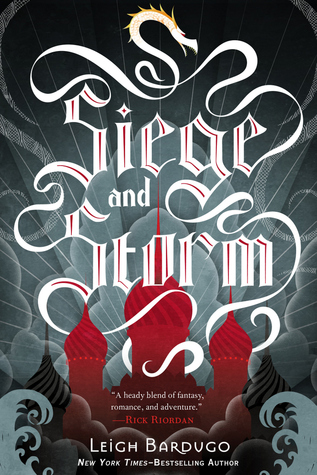
Siege and Storm, Leigh Bardugo

Siege and Storm (The Grisha, #2)Two weeks we'd been in Cofton, and I was still getting lost. The town lay inland, west of the Novyi Zem coast, miles from the harbor where we'd landed. Soon we would go farther, deep into the wilds of the Zemeni frontier. Maybe then we'd begin to feel safe. 

"Hunted across the True Sea, haunted by the lives she took on the Fold, Alina must try to make a life with Mal in an unfamiliar land. She finds starting new is not easy while keeping her identity as the Sun Summoner a secret. She can’t outrun her past or her destiny for long. The Darkling has emerged from the Shadow Fold with a terrifying new power and a dangerous plan that will test the very boundaries of the natural world. With the help of a notorious privateer, Alina returns to the country she abandoned, determined to fight the forces gathering against Ravka. But as her power grows, Alina slips deeper into the Darkling’s game of forbidden magic, and farther away from Mal. Somehow, she will have to choose between her country, her power, and the love she always thought would guide her--or risk losing everything to the oncoming storm."

*Spoilers for Shadow and Bone*

Siege and Storm was an excellent sequel to Shadow and Bone, a book I didn't love the first time around, but which upon rereading, improved a lot. The book starts off when Alina and Mal are in exile, but the Darkling shows up very quickly, with a terrible new power. There's not all that much development; the action starts right away (within the first chapter, in fact). The book might even be better than Shadow and Bone; there are a lot of great new characters introduced, and the book is a lot more action-packed, gripping and suspenseful. The writing also drew me in immediately, which didn't happen with Shadow and Bone. it took a bit longer to get into, even though it started off pretty early with action.

Another reason, I think, why I enjoyed Siege and Storm much more is that the sequel didn't have a love triangle like the small one in the first book. At least, until it progressed. Of course, there had to be some sort of triangle (or quadrangle) however small, to preserve its YA. For some reason, though, it didn't bother me quite as much. At least here, Alina knows that the Darkling is evil and wants to expand the Shadow Fold, even though some of what he says does ring true to her, about never really fitting in, about her power, about being hunted. And most importantly, Alina's growing knowledge of her and Mal's differences. Even though Alina (rightly) hates the Darkling, it cannot be denied that they do have a lot in common; both of them know what it is like to be alienated and to have great power, marking them out from other people. The way they choose to use their powers of light and dark, however, differs vastly. The Darkling is bent on expanding the Fold and his power; Alina on leaving Ravka forever. However, it becomes increasingly clear that that course of action is impossible. 

I think there were great descriptions of how many of the Grisha, who aren't bad people, just go along with the Darkling's plans rather than standing up to him. Take Genya, for example, who was a really good friend to Alina while she was in the palace. She's not a bad person, but she lied to Alina (whose letters to Mal were never sent). She stays by the Darkling because he rescued her from the Queen, and in part because she's too scared to do anything else. 

I really liked the character of Stormhound, the roguish privateer who by turns helps and harms Alina and Mal. He was an interesting mix of contradictions; he'll sell anyone out for a large price, he likes making dangerous and powerful enemies, but he's also very much a patriot towards Ravka, his home country. And as it turns out, he's not who he seems to be. 

In Siege and Storm, more of Ravkan (Russian) culture is explained and expanded upon. There are three animals: the stag whose antlers Alina claimed in the first book, the white sea serpent, and the firebird. I'm really interested by the firebird, a mythical creature that plays heavily in the tales of both the fictional world of Ravka, and the real world of Russia (see Stravinsky's Firebird, an amazing piece). This part of the plot, however, wasn't too original: the main character is different from all the others of her kind, and can be more powerful than everyone, breaking the basic rules of the world. Etc, etc. Still, I have to say that it's a plot device that works really well.

There are lots of deep, dark, secrets revealed in Siege and Storm, and I have a feeling that there are more that have not yet come to light, such as where Alina really was from before she went to the orphanage. Still, a lot is revealed in this amazing second book, and sometimes those revealings create still more complications. 

I loved Siege and Storm, and am definitely looking forward to the third book and final book whenever it comes out (probably summer 2014). The question is, how will I wait that long?

432 pages. 

Rating: *****

Sunday, September 15, 2013

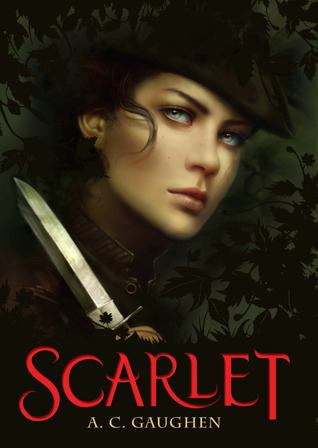
Scarlet, A.C. Gaughen

11983940No one really knows 'bout me. I'm Rob's secret, I'm his informant, I'm his shadow in dark places. No one ever takes me for more than a knockabout lad, a whip of a boy. They never really see. 

"Will Scarlet is good at two things: stealing from the rich and keeping secrets - skills that are in high demand in Robin Hood's band of thieves, who protect the people of Nottingham from the evil sheriff. Scarlet's biggest secret of all is one only Robin and his men know...that she is posing as a thief; that the slip of a boy who is fast with sharp knives is really a girl. The terrible events in her past that led Scarlet to hide her real identity are in danger of being exposed when the thief taker Lord Gisbourne arrives in town to rid Nottingham of the Hood and his men once and for all. As Gisbourne closes in and puts innocent lives at risk, Scarlet must decide how much the people of Nottingham mean to her, especially John Little, a flirtatious fellow outlaw, and Robin, whose quick smiles have the rare power to unsettle her. There is real honor among these thieves and so much more - making this a fight worth dying for." (Lovely rhyme there, by the way).

I enjoyed Scarlet, a work of YA historical fiction and romance. The plot conceit of a girl dressed as a boy is a very good one, and it was done pretty well in Scarlet. I didn't always love the ungrammatical writing style; it felt inconsistent and kind of unrealistic. Still, there were great details and language. As Scarlet would say, it were a pretty good book, although probably historically very inaccurate. I enjoyed both the characters of Robin and Scarlet; they felt like real people (with chemistry) as opposed to glorified idols. I find the story of Robin Hood really fascinating. Scarlet was a bit annoying at the beginning though, with her stubborn insistence on not eating or taking orders or accepting help from anyone. She's angry when Robin wants her to take someone else with her when going to a prison to help someone escape. I suppose it would be infuriating to be offered help just because you're a girl, but that's not why Robin does it; it's because he wants to make sure she's all right. And also, because sneaking into a prison is, you know, hard. 

The writing was totally unremarkable, but as the book went on, it started to pick up. The story itself is very good, as is the adventure. The quiet moments were interesting too. Scarlet gives more detail into how the band actually lives: where they sleep, eat, etc. Obviously, the story differs vastly from the traditional tale, as there's no obvious Maid Marian (although that's part of the easily-guessed secret). But I still liked the way it was told, and as the book went on, I got used to the somewhat odd writing style. The book wasn't a really fast read, but it didn't take that long to read either, with lots of action (though not quite as much as I would have liked), dialogue, and not a whole lot of description.

The romance with John Little served no other purpose than to make Robin jealous, as far as I could see. That part was definitely annoying, and I wish Scarlet would have been a bit firmer in her feelings. At first, it wasn't too bad, but as the book went on, this part of the novel annoyed me more and more; a lot of the parts with John could have probably been cut out, and the book would have been better for it. Of course, they all have much more important things to worry about, her particularly, what with Gisbourne in town and determined to catch them.

Scarlet's dark, secret past was pretty easy to figure outt, especially given the original Robin Hood tale; before she joined Robin's band, she was in London with someone named "Joanna", and throughout the book, bad things relating to Gisbourne that happened to them are hinted at. It's not revealed for quite a while, though, and there were a lot of details that I really wanted to know earlier. Still, the mystery aspect was part of the novel, and woven in pretty nicely. 

Scarlet was a good but not great YA historical fiction retelling of the classic myth. Its half love triangle thing (I'm not sure what to call it) was not good, and the writing wasn't amazing, but other than that it was well-paced and plotted, and I liked it. 

287 pages. 

Rating: 3.5 stars. (between good and really good).

Saturday, September 14, 2013

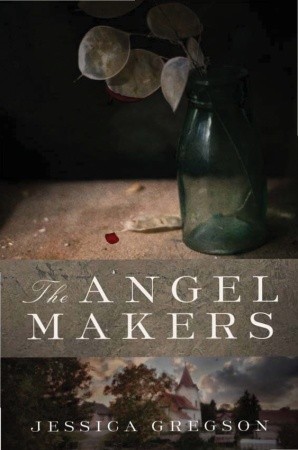
The Angel Makers, Jessica Gregson

The Angel MakersSari is fourteen years old when they carry her father out, carry him through the village lanes, his face bare and blank to the wide sky, carry him through the summer wildflowers that bloom alongside the river, carry him to the cemetery. 

"When the men of a remote Hungarian village go off to war in 1916, the women left behind realize their lives are much better without them. Suddenly, they are not being beaten; they have time for friendships; they even find romance with the injured Italian soldiers staying just outside of town.  For Sari, an intelligent girl who's always been an outcast (her fellow villagers suspect her of being a witch because of her medical knowledge), it's the first time in her life she's had friends. When the men return at war's end, the freedom Sari and the others have enjoyed is suddenly snatched from them, and they realize they need to do whatever it takes to hold onto it. Sari puts her medical knowledge to use to off her husband. Then she helps one of her friends. And another. When the word spreads, she realizes her problems are only beginning. This creeping and hugely readable first novel is based on a true story."

The Angel Makers is a fairly well-narrated work of historical fiction, although it is a mixture of fiction and nonfiction, being based on a true story but with lots of changes made by the author. I'd be curious to read a summary of what actually happened, although not a full-length nonfiction book; this story isn't that interesting. I checked The Angel Makers out of the library, and was glad that I did so; it's not a book I would reread or anything. However, it is pretty entertaining and somewhat thought-provoking. It makes one think about the repression of women in rural areas in Europe even in the twentieth century. And such things were still going on in more populous and educated regions. 

There were some parts of this book that felt a bit off; the cursing, for example. The women in this small village use a lot of curse words that don't seem realistic. I don't know. I'm just not sure I liked that choice of the author. It's just a little hard to take the historical setting seriously when the women are using the f-word. But it might be historically accurate in terms of the language; I really have no idea. That was a minor criticism: my more major one was that the story took a long time getting off the ground. Sixty pages in, a fair amount has happened, but it doesn't feel like anything has happened really, even though Sari's father has died, the men have gone off to war, and the Italian prisoners have arrived. (Incidentally, Sari isn't really a very Germanic name, is it?) I suppose that's a lot that has happened, but it still felt very much like the earliest development of the novel. 

Despite the slowness of the novel, I enjoyed The Angel Makers, which was a fairly intriguing story. As I read more though, the cursing got more and more distracting and annoying. There was just something off about The Angel Makers: historically and the way it was written. It was certainly very different than what I was expecting. I didn't dislike it, but I certainly didn't love it. 

I did think Sari was an interesting character, even if most of the secondary characters were thinly developed. Sari, however, is a very intelligent and interesting young woman; feared by the community before the war, once it begins they all being to develop a grudging respect for her, and at least tolerance. Really, Sari was the only character who felt well developed to me, although I did enjoy reading about some of the other people in the story. 

There's a description of Italian in the book that I really liked: "a language that sounds like bubbles blown underwater." (pg. 66). It was a nice simile. At another point Italian is compared to "smooth, round pebbles dropping into still water." (pg. 103). Both of these have to do with water, and indeed Italian has a very liquid, flowing sound to it. It's a beautiful language, and it's no wonder that traditional operas were all sung in Italian. 

The Angel Makers wasn't bad, but I would recommend checking it out of the library, as it's not a great book. 

340 pages.

Rating: ***