Wednesday, May 8, 2013

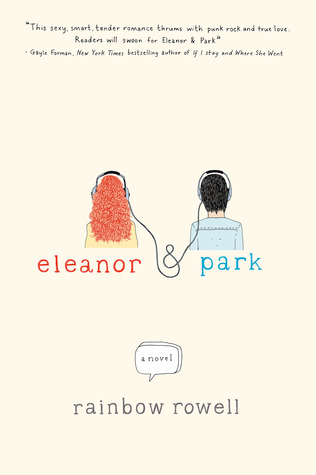
Eleanor & Park, Rainbow Rowell

Eleanor & ParkHe'd stopped trying to bring her back.

She only came back when she felt like it, in dreams and lies and broken-down déjà vu.

Like, he’d be driving to work, and he’d see a girl with red hair standing on the corner—and he’d swear, for half a choking moment, that it was her.

Then he’d see that the girl’s hair was more blond than red.

And that she was holding a cigarette . . . And wearing a Sex Pistols T-shirt.

Eleanor hated the Sex Pistols.

Eleanor . . .
Standing behind him until he turned his head. Lying next to him just before he woke up. Making everyone else seem drabber and flatter and never good enough.

Eleanor ruining everything.

Eleanor, gone.

He’d stopped trying to bring her back.

What an intense first prologue. It really captures what the book is like. "Set over the course of one school year in 1986, Eleanor and Park is the story of two star-crossed misfits – smart enough to know that first love almost never lasts, but brave and desperate enough to try." Eleanor and Park didn't immediately draw me in; it's a book that starts slowly. You don't realize that you're absorbed until it's too late, just like Eleanor and Park don't realize how much they care for one another until it's too late. 

That said, contemporary romance is really not one of my favorite genres, and as I was reading Eleanor & Park I remembered why. It's a better romance than most, obviously, but it was still really sappy and unrealistic at times. It was kind of like insta-love. I could really see how Eleanor and Park might go from ignoring one another to being friends, but the romance, the central part of the story, just didn't work for me. How could they suddenly love each other so, so much after like two weeks? It all felt forced, and the construct of them reading comics together didn't feel real to me. 

I did like the contrast between Eleanor's home life and Park's home life. Park's family is basically perfect, except for some minor quarrels with his father, whereas Eleanor is living in a tiny home with her mother, siblings, and her horrible step-father. But the thing is, even that didn't feel right to me. Nothing about this realistic novel seemed realistic. There are fantasies that feel more realistic than Eleanor & Park, if that makes sense. The world created in some fantasy novels just works, but it didn't in this novel. I also didn't understand why Eleanor's mom put up with her second husband, who's clearly a jerk. The book isn't set in the 19th century; it's set in 1986. There's such a thing as a divorce, as the police. 

But the thing is, in some ways, I really liked Rainbow Rowell's writing style even though so many aspects of the novel didn't work for me. I think she has major potential, but this one just didn't work for me. But she is a good writer, and another book could be very good. She already has one other novel, Attachments. 

I guess I was just expecting Eleanor & Park to be very good and very life-changing. It was neither of those.  What it was was full of cliches. The whole love-at-first sight thing can work sometimes, but it didn't work in Eleanor & Park. I got really annoyed with both of the main characters. Also, there seems to be a thing to set YA fiction in the late 80's and early 90's, so that you can have mix-tapes and Walkman's. As far as I can see, that and the music they were listening to was the only reason that Eleanor & Park is set in 1986. So the time period really didn't work for me either. 

(Sigh). I really wanted to like this book, but I didn't. At times it was even cringe-worthy, and I struggled with finishing it. It was a real disappointment to me, although I will say that it was very gripping and the later sections were a bit better. I also liked the way the book ended, and the second half redeemed itself a bit. For the type of book that it is, Eleanor & Park has a great ending, but overall it left me wanting something more. Thanks to St. Martin's for providing me with a review copy. 

Read Eleanor & Park:
  • if you like realistic fiction
  • if you like romance
  • if you like John Green (he liked Eleanor and Park)
325 pages. 
 
Okay book, but it left me wanting more!

It got better as it progressed, but it still could have been a much more compelling book.

Tuesday, May 7, 2013

Sanditon: Jane Austen's Last Novel Completed, Jane Austen & "Another Lady"

Sanditon: Jane Austen's Last Novel CompletedA gentleman and a lady travelling from Tunbridge towards that part of the Sussex coast which lies between Hastings and Eastbourne, being induced by business to quit the high road and attempt a very rough lane, were overturned in toiling up its long ascent, half rock, half sand.

This version of Sanditon has been completed by an author who styles herself merely "Another Lady", just like Austen was "A Lady". Although Goodreads says that her name is Anne Telscombe. In any case, I read the original fragment of Sanditon fairly recently along with Lady Susan and The Watsons. I knew that there was a completion of the novel out there, and I managed to get my hands on it. I was curious to see how the events would play out. Here's a plot summary of Sanditon: "Written in the last months of Austen's life, the uncompleted novel Sanditon is set in a newly established seaside resort, with a glorious cast of hypochondriacs and speculators,and shows the author contemplating a changing society with a mixture of scepticism and amusement."Here is the summary for the completed version: "Charlotte the Heywood, captivating heroine of Sanditon, is smart, beautiful, and in search of a husband. As in all of Austen's novels, however, the road to matrimony is littered with obstacles: Charlotte must escape the clutches of an insufferable suitor, deal with the fortune-hunting schemes of the reigning local dowager, and outsmart a bevy of ambitious beauties who have set their sights on the charming Sidney Parker -- and convince the fickle young man that he really loves her." As you can see, these are two very different summaries, emphasizing very different things. 

Here were my thoughts on Sanditon when I read the original: "I loved Sanditon just as much as Lady Susan and The Watsons. It's so short though, and now I definitely want to read the edition completed by "another lady". Though it wouldn't be legit. You know what I'm talking about, right? The end isn't written by Austen, so it's not "real"...even though none of it is real. Still, I loved the  characters in Sanditon; they really came to life. Once again, the commentary was illuminating. Austen was basically dying while she wrote Sanditon, so it's really not surprising that health is a major topic in the book. But it's treated differently than you might expect. Jane Austen mocks the many hypochondriacs in this book."

"Another Lady" takes over in the middle of the eleventh chapter. The transition on page 73 is pretty seamless, I have to say. The second authoress imitates Austen's style, and completes the novel pretty well. Charlotte does turn out to be a little less level-headed and the events more sensational than I think Austen intended, but still, the novel was entertaining, and it had an ending! (Obviously). Indeed, I sometimes forgot that I was no longer reading Jane Austen. Still, I am a bit uneasy about the fact that none of the rest of it is "authentic". I mean, it's all fiction, but the part not written by Austen isn't part of the canon, I suppose you would say. It was still really good though.

Having just read Vanity Fair (though I published my review a few weeks ago), I was able to see the many differences between the two books, though they are set in basically the same time period. Vanity Fair is of course a satire, making its tone more mocking. Austen likes to be playful too, but not in the same way. The second really major difference is that there are so many references in Vanity Fair to things that the modern reader does not know about (hence, extensive footnotes must be read). Whereas there's not much of that in Austen. There are some references, but definitely not 40 in a chapter, as sometimes happens in Vanity Fair. Only 1 or 2 or possibly 3 at most. You don't even really need to read the footnotes to understand most of the story. Austen does make reference to a lot of popular novels at the time. A semi-related thing is that Austen's books are all set during the war with Napoleon, but although there are many officers, the war is never mentioned at all. It plays a very major part in Vanity Fair. So that's a huge difference.

Sanditon is seemingly not the most exciting of Austen's novels, but it was really interesting to see how "Another Lady" developed the characters and their complex, subtle relationships with one another. I was also really gripped by the story and couldn't put it down. As Charlotte observes, "It was so very clearly not what it appeared on the surface." (pg. 81). And that's the best thing about this novel and all of Austen's novels for that matter; it's very clearly not just what it seems on the surface. The cast of characters, the dialogue, everything in Sanditon is deeper than it appears.

Speaking of quotes, there were a lot that I bookmarked to add to this review. Here are some of them:

"They never fail me. Women are the only correspondents to be depended on." (pg. 25), said by Mr. Parker. I'm not sure if that's true, but it is interesting.

(Charlotte thinking about Lady Denham, the great lady of Sanditon): "She is thoroughly mean. I had not expected anything so bad. Mr Parker spoke too mildly of her. His judgement is evidently not to be trusted. His own good nature misleads him. He is too kind-hearted to see clearly. I must judge for myself. And their very connection prejudices him. He has persuaded her to engage in the same speculation, and because their object in that line is the same, he fancies she feels like him in others. But she is very, very mean. I can see no good in her. Poor Miss Brereton! And she makes everybody mean about her. This poor Sir Edward and his sister - how far nature meant them to be respectable I cannot tell - but they are obliged to be mean in their servility to her. And I am mean, too, in giving her my attention with the appearance of coinciding with her. Thus it is, when rich people are sordid." (pgs. 44-45). It was mainly the last sentence that I was intrigued by, but one needs the whole paragraph for context.

Here's more of a humorous quote. "'I hope you like dry toast' (said Arthur Parker). 'With a reasonable quantity of butter spread over it, very much,' said Charlotte, 'but not otherwise.'" (pg. 61).

An interesting one: "'Very few of us lack superficial faults and we must rely on each other's kindness to overlook them.' (said Charlotte). 'But people take such trouble with their faults and go to such lengths to make them fascinating to others that it  is really very unkind to overlook them,' protested Sidney. 'They would much rather be laughed at than politely ignored.' Charlotte could not help smiling at so light-hearted a view..." (pg. 97).

"'...but I feel Sir Edward's company is best partaken of sparingly, in small doses - say at half-hour intervals.'" (pg. 116, said by Sidney Parker).

"'People vary so much that I find it both dull and pointless to discuss them except as individuals.'" (pg. 117, also said by Sidney Parker).

The next time I read another Austen novel, I'll probably find some amazing quotes to feature. There's no shortage of them, and there were many more from the later parts of Sanditon. As is probably obvious, the "said Arthur Parker" and the "said Charlotte" were not in the book. I just added them so that the quotes could be less confusing.

This one was not a thrilling novel at first, though I ended being really absorbed by it, but it is certainly interesting, and "Another Lady" finished it well. If you enjoy Jane Austen, this is an excellent book to read, portraying a changing society with "a mixture of scepticism and amusement." I loved it.

Read Sanditon:
  • if you like Jane Austen
  • if you like British literature
  • if you like stories of changing societies
312 pages.
 
Outstanding Book That Will Stay On My Bookshelf For Rereading (jf I own it)!

Monday, May 6, 2013

A Christmas Carol and Other Christmas Stories, Charles Dickens

A Christmas Carol and Other Christmas WritingsA Christmas Carol: And Other Christmas StoriesMarley was dead, to begin with, there is no doubt whatever about that. The register of his burial was signed by the clergyman, the clerk, the undertaker, and the chief mourner. Scrooge signed it. And Scrooge's name was good upon 'Change for anything he chose to put his hand to.

Even though I don't celebrate Christmas, I still enjoyed A Christmas Carol (And Other Christmas Stories). It's a really good story, with really great writing. It's also one of Dickens's most famous works. A Christmas Carol is very well known; it's the story of the miserly Ebenezer Scrooge, who is a sort of 19th century Grinch. Right off, I want to say that I'm not overly fond of Christmas myself (especially the consumerism), but Scrooge hates it, and doesn't even want to wish anyone a Merry Christmas. One year, he gets taught a lesson by the ghost of his old partner Marley and three other spirits, The Ghost of Christmases past, present, and future. The other pieces in this collection (cover on right) are: "A Christmas Tree (from reprinted pieces), A Christmas Dinner (from sketches by Boz), and A Good-Humoured Christmas (Chapters 28 and 29 from The Pickwick papers)."

I think I've read the beginning of A Christmas Carol a while ago, but I never finished it, and I had certainly never read the other works in this collection. I was very pleasantly surprised; Dickens can be really, really overwritten, but A Christmas Carol wasn't overwritten at all. Perhaps he wasn't getting paid by the word for it. There were some great descriptions of food in A Christmas Carol: of goose and pudding and fruit and other delicious treats. My only criticism is that Scrooge seems to reform rather quickly; as soon as the first spirit arrives he seems ready to repent of everything he's done. I don't think it's that easy in real life to change a person from a humbug to a philanthrope. Still, it's a pretty heart-warming story, and a lot better written than a lot of Dickens's novels. Even the ones that I love (like A Tale of Two Cities) are really dense when compared to this one. (pgs. 30-138).

A Christmas Tree was a rather verbose and drawn-out description. It's just pondering about everything about Christmas. I may have skimmed through most of it. There some witty sentences, but it's nothing exceptional. It's still less overwritten than many of Dickens's full length novels. (pgs. 139-162). A Christmas Dinner is very similar, although there are actual characters in this sketch. It's only seven pages though, and not much happens. I'm not really sure why these two were included in the book. 

A Good-Humoured Christmas is an excerpt from The Pickwick Papers, which I want to read eventually. It was better than A Christmas Tree and A Christmas Dinner, though I confess that I skimmed over some parts of it. At least there are actual characters, and time to develop them. I didn't really know who the characters were, however, since I've never read the book from which the chapters are from, and only vaguely remember them from Little Women. Still, it's an enjoyable story. (pgs. 171-218). 

Those are all the stories in the collection, which overall is very good. 

Read A Christmas Carol and Other Writings:
  • if you like Charles Dickens
  • if you like tales of Christmas
  • if you like British literature
218 pages. 
 
Very Good! I would recommend this book!

Sunday, May 5, 2013

The Catcher in the Rye, J.D. Salinger

The Catcher in the RyeThe Catcher in the RyeIf you really want to hear about it, the first thing you'll probably want to know is where I was born, and what my lousy childhood was like, and how my parents were occupied and all before they had me, and all that David Copperfield kind of crap, but I don't feel  like going into it, if you want to know the truth. 

I ended up loving The Catcher in the Rye. I really wish I had read it sooner. It is the story of Holden Caulfield, our hero-narrator. As the book opens, he is kicked out of his third high school. He has flunked all of his courses except English. Holden himself is so complex. He's immature and there's this tough exterior, but inside, he's really longing for more, for some emotional commitment. He's also really compassionate, and though he's expelled from school, he's actually really smart in some respects. He reads a lot and talks about the books so well. Holden has so much pain which you can tell he is trying to conceal.

The best thing about this novel is probably the voice. Holden's narration is so compelling, so amazing, and so surprising. He curses a lot, but he is also so wise, and some of his descriptions so amazing. I kind of distrusted him though; he freely admits to lying a lot and well throughout the book. So for a while I thought that he was lying to the reader. But whether he was lying or not, I loved the book from the beginning. Especially when he's thinking about his time with Jane, which is so much more meaningful than anything else.

The Catcher in the Rye reminded me of The Outsiders a little bit. In both, the book is narrated by a troubled but surprisingly smart teenage boy living in the city who gets into some trouble. The Catcher in the Rye is kind of a depressing book; Holden is depressed a lot by things he sees, and some of that rubbed off on me while I was reading it. Holden sees everything as totally meaningless and ungenuine. He calls things "corny" and "phony" a lot. It also reminded me of a better, more complicated version of The Perks of Being A Wallflower. I kind of wished that The Catcher in the Rye would have resolved the questions that it posed to some extent. It didn't though, which was probably good in the end. Questions like the one in this book can't ever be "answered".

The Catcher in the Rye was very depressing and somewhat repetitive, but I still read it really quickly, and I still loved it. I was surprised by how much I enjoyed the writing and the characters. The way that Holden hates movies and that his brother threw away his writing talent to write screenplays really kills me, as Holden would say.

214 pages.
 
Outstanding Book That Will Stay On My Bookshelf For Rereading (jf I own it)!

Saturday, May 4, 2013

Sweet Tooth, Ian McEwan


Sweet ToothMy name is Serena Frome (rhymes with plume) and almost forty years ago I was sent on a secret mission for the British Security Service. I didn't return safely. Within eighteen months of joining I was sacked, having disgraced myself and ruined my lover, though he certainly had a hand in his own undoing.

Sweet Tooth was an interesting, though somewhat disappointing read. I heard about it from the New York Times, and thought it sounded really intriguing. The writing was interesting, but fell a little flat. "Cambridge student Serena Frome’s beauty and intelligence make her the ideal recruit for MI5. The year is 1972. The Cold War is far from over. England’s legendary intelligence agency is determined to manipulate the cultural conversation by funding writers whose politics align with those of the government. The operation is code named “Sweet Tooth.” Serena, a compulsive reader of novels, is the perfect candidate to infiltrate the literary circle of a promising young writer named Tom Haley. At first, she loves his stories. Then she begins to love the man. How long can she conceal her undercover life? To answer that question, Serena must abandon the first rule of espionage: trust no one."

As I said, Sweet Tooth was interesting, but not really compelling. The writing felt like it was trying to be too clever, and like McEwan knew of his own cleverness. In doing so, he destroyed it. But the book did get better as it went on. I didn't like the beginning sections, but once Serena got her assignment, things started to get a bit more interesting. It still wasn't amazing, but it was much better. I really liked hearing Serena's thought process. She's got a complicated life which she has to work through. 

Part of what was a bit off-putting was that Sweet Tooth was really different from what I was expecting. I guess I hadn't really read the plot summary closely enough. It's not really a spy novel at all, not very suspenseful. I didn't really understand why soliciting Tom Haley was so important. Did something like this really happen in Britain in the 1970's? How is it going to help in the Cold War? All of that was a bit sketchy, and the book wasn't a thriller, that's for sure. But it was still pretty good and very lyrical. As I said, it got better the more the plot developed. 

One thing I did really like about Sweet Tooth was Serena as a character. Like me, she races through books, and I could really identify with her in that respect. Serena reads a page in 3 or 4 seconds. I'm not quite that fast, but almost. In other respects, however, Serena felt very different from me. She was kind of cruel sometimes, but I still enjoyed her as a character. Tom Haley was interesting, but not likable. He was a jerk sometimes.  Here's a quote that I liked: "Love doesn't grow at a steady rate, but advances in surges, bolts, wild leaps, and this was one of them." (pg. 191). The wording could have been better, but it did stand out to me.       

Sweet Tooth was an intriguing novel. I didn't love it, though I ended up enjoying it. Still, it's not really worth buying (though I did). Checking it out of the library is advised. 

Read Sweet Tooth:
  • if you like historical fiction 
  • if you like books set during the Cold War
  • if you like spy novels (though this isn't really one)
  • if you like books of doomed love affairs
301 pages, 3.5 stars.

Friday, May 3, 2013

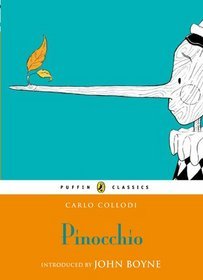
Pinocchio, Carlo Collodi

PinocchioPinocchioOnce upon a time there was..."A king!" my little readers will say at once. No, children, you're wrong. Once upon a time there was a piece of wood. 

This is the original story of Pinnochio, vastly different from the Disney animated cartoon. It really is a moral fable, with all sorts of lessons. It's still really entertaining and well-written, though. The story begins with a piece of wood, "not a fancy piece of wood, just a regular woodpile log, the kind you might put in your stove or fireplace to stoke a fire and heat your room". Master Cherry brings it home and starts to hear it talking to him. He gives it away to the poor puppet-maker Geppetto, who makes a puppet out of it. And thus Pinocchio is born. But what a rascal he is! First of all he gets his father put in jail, and then he eats all of his father's food, of which there isn't much. Then, Geppetto sells his coat in order to get Pinocchio a spelling book. But as we know, not all goes well on Pinocchio's way to school. He encounters the Cat and the Fox, one of the greasiest pair of swindlers in literature. The rest of this rather short book tells of his subsequent misfortunes and adventures. We meet the Fairy with the Sky Blue Hair, as well as several talking animals. I haven't seen the cartoon in ages, but a lot of the same events happen in the original book. But there are also a lot of things in the book that aren't in the animation, and vice versa. For example, there is a cricket in Pinocchio, but he plays a relatively minor role, although he is important to some extent.

Pinocchio is a really awful child. He gets others into all sorts of trouble, and of course, himself. He's really gullible too. When the Cat and the Fox tell him that he can triple his wealth by burying his coins in the ground, he believes them. He never suspects them of anything until after it's too late, not even when he cuts off a bandit's hand and it turns out to be a cat paw. Then he falls in with the wrong crowd at school, who get him into more trouble. He never will learn, which makes for frustrating reading. I wanted to knock some sense into him. Every time after he makes a mistake, Pinocchio promises that he'll never do it again, but he does. Eventually, however, he learns, and becomes a good little boy.

I love the writing in Pinocchio; though it was written in the 19th century, it's not overwritten at all. The writing is quite distinctive, but really easy to get through and really compelling. I read Pinocchio very, very quickly, in probably an hour or two all told. It's a great work of fantasy, a great fairy tale, and a great moral tale. I would highly recommend Pinocchio. It's an amazing story with many amazing elements. I can see how the morality aspect of it might get on some people's nerves, but I loved it.

Read Pinocchio:
  • if you like fantasy
  • if you like Italian fiction
  • if you like fairy tales
  • if you like the Disney cartoon
160 pages.
 
Outstanding Book That Will Stay On My Bookshelf For Rereading (jf I own it)!

Thursday, May 2, 2013

The Silmarillion, J.R.R. Tolkien

The SilmarillionThere was Eru, the One, who in Arda is called Iluvatar; and he made the first Ainur, the Holy Ones, that were the offspring of his thought, and they were with him before aught else was made. 

The Silmarillion is what you might call a prequel to the events in The Lord of the Rings. Tolkien considered it his most important work, and it's basically a collection of legends about the creation of Middle-earth. "...this is the ancient drama to which the characters in The Lord of the Rings look back and in whose events some of them, such as Elrond and Galadriel, took part. The three Silmarils were jewels created by Feanor, most gifted of the Elves. Within them was imprisoned the Light of the Two Trees of Valinor before the Trees themselves were destroyed by Morgoth, the first Dark Lord. Thereafter, the unsullied Light of Valinor live on only in the Silmarils, but they were seized by Morgoth and set in his crown, which was guarded in the impenetrable fortress of Angband in the north of Middle-earth.The Silmarillion is the history of the rebellion of Feanor and his kindred against the gods, their exile from Valinor and return to Middle-earth, and their war, hopeless despite all their heroism, against the great Enemy."

A lot of it went over my head; I'm not a huge Tolkien fan, and the beginning of The Silmarillion (as you can see) was really Biblical. Plus, there were so many very similar names of the different Ainur that I didn't really absorb most of them. I'm sure if you gave me a test on the characters I would fail utterly. Nevertheless, The Silmarillion was quite good, though definitely my least favorite of Tolkien's works.

The story itself is really interesting. It tells of the creation of a whole new world and a really complex system, and of the epic fight between good and evil. A lot of it stylistically reminded me of Norse epics: long-winded and with many, many names. Really, as the book progressed, I couldn't keep anything straight. It was all so confusing. The Silmarillion could have done with a lot less names, and a lot more straightforward action. Still, I can see how a particular friend of mine is really obsessed with it; there are so many different threads of The Silmarillion that can be thought more about and written about and talked about. It just wasn't that compelling for me.

Still, I can certainly see why Tolkien considered it his most important book. It sets the whole foundation for the whole Lord of the Rings trilogy. If none of these things had ever happened, none of the subsequent adventures would have taken place. So yes, The Silmarillion is quite important, it's just not my type of fiction.

I'm glad that I made my way through it, though. I enjoyed parts of it, and the story itself was a really good one. It's definitely worth reading if you enjoyed The Lord of the Rings. The Silmarillion is basically this big book of legends, and it's of great value. I didn't love it, but I did like it, despite it being difficult to get through.

Read The Silmarillion:
  • if you like J.R.R. Tolkien
  • if you like fantasy
  • if you like mythology
304 pages.
 
Very Good! I would recommend this book!